Table of Contents
Streaming content has now become a part of life. Times have changed with the internet evolution. However, you find a lot of people unhappy with their streaming experience. That is when services like VPN and VPS can help you.
Even though VPN and VPS seem quite similar, their features are quite different. In this blog, we will look at both VPN and VPS to see what separates them and which one is ideal for streaming purposes.
Understanding VPN and VPS
People often get confused with VPN and VPS because of the way they sound. However, they both offer different types of services. A Virtual Private Network (VPN) is a network of servers. It encrypts your internet connection and ensures your online streaming is safe and anonymous.
VPN makes you look like you are browsing the internet from a different location even though you aren’t. You can also bypass geo-restricted content, access censored content, and protect your privacy. However, make sure to use a reputable VPN in the market that can provide assurance and top privacy while streaming.
Similarly, A VPS (Virtual Private Server) is a kind of computer where you can host various websites. You can also install and run various software through it. It gives you the liberty to control and configure it how you want. But, you also need more technical knowledge.
Comparison: VPN vs VPS
What each one actually does
A VPS gives you a dedicated virtual server you control — you can run your own applications, host services, or even set up a personal streaming/proxy endpoint on it. A VPN, by contrast, just routes and encrypts your existing traffic through someone else’s server — it doesn’t give you compute or hosting capability, only a masked, secured connection.
IP address behavior
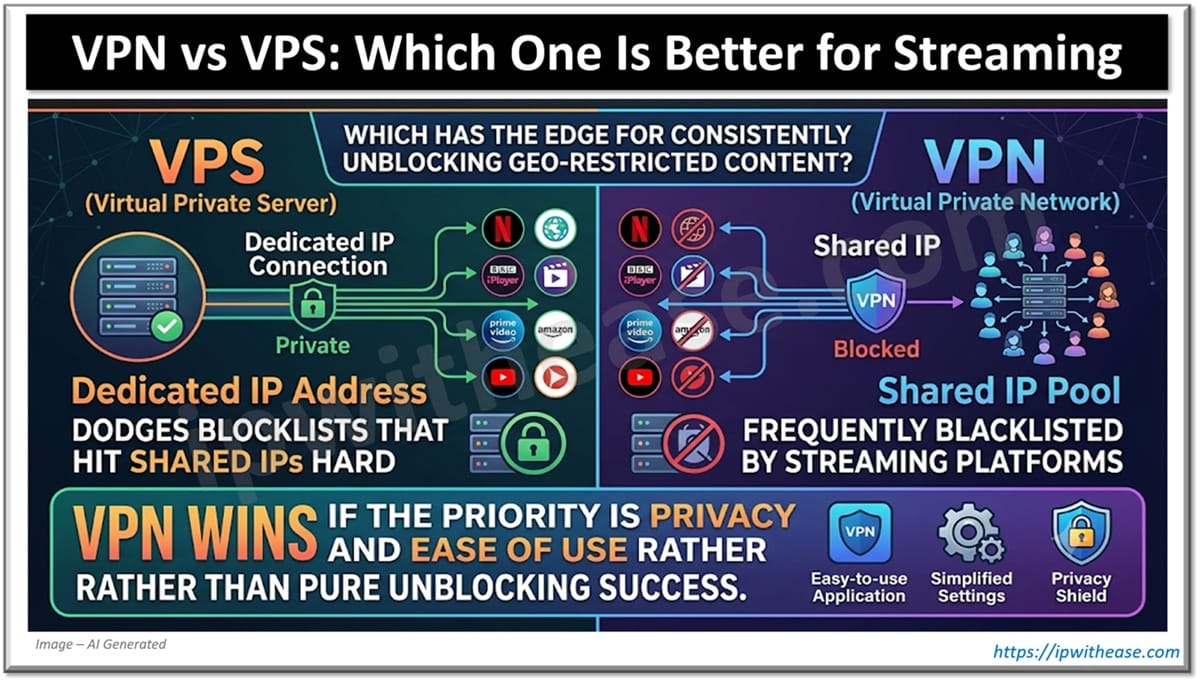
With a VPS, you typically get a dedicated IP tied only to you — much less likely to be flagged or blacklisted by streaming platforms since it isn’t shared across thousands of users. A VPN IP is usually shared among many subscribers, and popular VPN IP ranges are frequently detected and blocked by services like Netflix or Amazon Prime Video.
Streaming platform detection
Because VPN traffic patterns are well known, streaming services actively maintain blocklists against common VPN provider IP ranges. VPS IPs, being less predictable and often used for legitimate hosting, slip past these detection systems more consistently — this is the core reason VPS often wins for unblocking geo-restricted content.
Setup and technical effort
VPN is plug-and-play: install an app, pick a server, connect. A VPS requires manual setup — provisioning the server, configuring a proxy or VPN service on it yourself (e.g., via Shadowsocks or OpenVPN), and maintaining it. It’s a heavier lift but gives more control.
Speed and buffering
VPS connections are often faster for streaming since you’re not sharing bandwidth with other users on the same node, and you can choose server location/specs to suit throughput needs. VPN speeds vary a lot depending on provider load, encryption overhead, and server congestion.
Privacy and security
VPN is purpose-built for privacy — full traffic encryption, no-logs policies, kill switches. A VPS doesn’t inherently encrypt your traffic unless you configure that yourself, so out of the box it’s more about access than anonymity.
Cost and maintenance
VPN is a fixed monthly subscription with zero maintenance. VPS costs can be lower or higher depending on specs, but you’re responsible for server upkeep, security patching, and configuration — there’s no vendor handling that for you.
| Parameter | VPS | VPN |
|---|---|---|
| Primary function | Dedicated virtual server (hosting/compute) | Encrypted traffic tunnel |
| IP type | Dedicated, less likely blacklisted | Shared, frequently blocklisted |
| Streaming unblock success | Higher | Lower (many providers actively blocked) |
| Setup effort | Manual, technical | Plug-and-play |
| Speed for streaming | Generally faster (dedicated resources) | Variable, depends on server load |
| Built-in encryption | Not by default | Yes |
| Best for | Users wanting reliable unblocking + control | Users prioritizing privacy + simplicity |
| Maintenance | Self-managed | Fully managed by provider |
Benefits of Using a VPN
1. Ease of Use
You can use a VPN without much stress. Firstly, download the VPN app on your streaming device. Then, connect to a server that you wish to. That’s it! Your traffic is now secure.
2. Improves Streaming Performance
VPN at times can improve your streaming experience via a network of servers optimized for streaming. This can reduce buffering and improve the overall streaming experience. The main reason for this is VPN servers are usually located in data centers with fast internet connections and low latency.
3. Prevents ISP Throttling
Some ISPs lower the bandwidth of certain kinds of traffic while streaming videos. A VPN can stop ISP throttles by masking your traffic and making it difficult for your ISP to identify what type of content you are trying to stream.
4. Protecting Your Privacy
VPNs mask your internet traffic which makes it difficult for third parties to track your online activity. This will help you in protecting your privacy from advertisers, ISPs, and other malicious sites. It becomes more important when streaming on public Wi-Fi networks, which aren’t secure.
Benefits of Using a VPS
1. Improved Performance
VPSs can offer better streaming performance than shared hosting because they have dedicated resources. This means that the VPS will not be affected by other websites on the server that use many resources.
2. More Control
You will have full control over your hosting environment with a VPS. This means you can install any software you want and configure your server as you wish.
3. Scalability
VPSs are scalable, so you can easily upgrade your plan according to your growing needs. This is very important when streaming because your bandwidth and storage needs may increase gradually as you gain more viewers.
4. Security
These are more secure than the shared hosting. The reason for that is each VPS is located from the other VPSs on the server. This means the chances of your VPS getting affected by a security breach on another VPS are less.
Can I Use a VPN and VPS Together?
Yes, you can use a VPN and VPS together. These both are ideal ways to improve streaming security and privacy. However, make sure to choose a reputable VPN and VPS provider with a good reputation that offers various features and options.
Which One Is Better for Streaming?
VPN v VPS is an interesting topic and choosing one of them depends on what you want to achieve through them. If you want to bypass geographically restricted content and access censored content then opt for a reputed VPN. Moreover, they are pretty easy to use and you don’t need any technical expertise as compared to VPS.
However, if your goal is to improve your streaming experience, then VPS could be an ideal option. VPSs offer more bandwidth and processing power than shared hosting. This could lead to a smoother and more reliable streaming experience.
The Bottom Line
Ultimately, the choice between VPN and VPS depends on you. If you aim to experience great streaming while watching a video, then go for VPS. VPS is purely for bettering the streaming experience.
If you want additional security with multiple server options then choose a VPN. All in all, both are great options depending on the situation.
Continue Reading
VPN vs Proxy: Detailed Comparison
ABOUT THE AUTHOR

IPwithease is aimed at sharing knowledge across varied domains like Network, Security, Virtualization, Software, Wireless, etc.