Table of Contents
Provisioning of large scale cloud infrastructure and increased use of critical intelligence has brought a new set of threats in the digital landscape. Organizations are facing more complex, sophisticated, voluminous, and persistent cyber threats across the world.
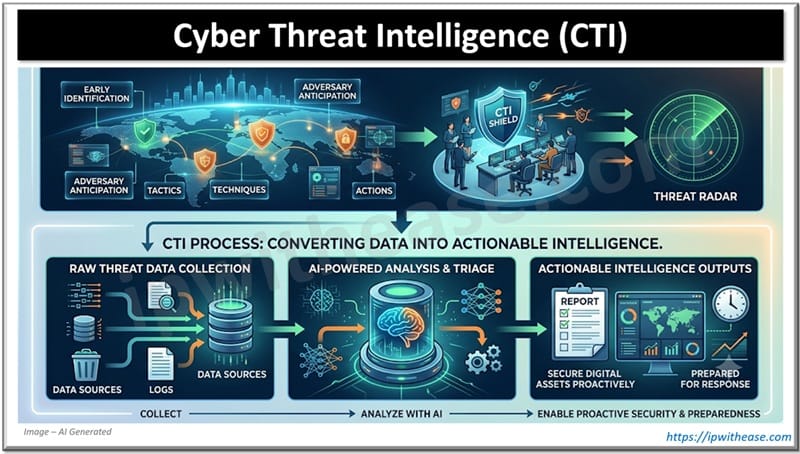
Cyber threat intelligence (CTI) is a prevention approach which aids in early identification of cyber threats and helps organizations in anticipating the tactics, techniques and actions taken by adversaries.
Raw threat data is analysed using AI and converted into actionable intelligence to enable organizations to secure their digital assets proactively by applying stringent controls and be prepared for response on potential threats.
In today’s article we will understand cyber threat intelligence and its importance in 2026.
Cyber Threat Intelligence (CTI)
Cyber threat intelligence is the process of collection, analysis, and intercept meaningful pattern from raw data which is related to existing or new cyber threats. This technique requires tools, tactics and procedure knowledge which is used by bad threat actors to understand the intention behind the malicious attack and apply that knowledge to strengthen cyber defense. Raw data such as vulnerabilities, attack patterns and compromise indicators) are converted into actionable tasks. The security teams use these insights to prepare better defense of the digital landscape and leverage Cyber threat intelligence knowledge to strengthen the overall security posture of the organization.
Why it Matters in Present Times
Threat intelligence is becoming more crucial and important for security teams, leadership and management because the AI adoption is at accelerated speed not just by organizations but by bad actors as well which are changing the threat landscape drastically. The current measures are falling in front of AI led attacks which have surpassed the human limits of imagination and speed.
Threat intelligence is also evolved parallelly with direct feeds going into SOAR, SIEM and XDR systems. Manual efforts are getting reduced and response times are shortening. Cross industry intelligence sharing is tremendously increased supported by national bodies and other trust communities.
Threat intelligence feeds use a variety of sources which defer in depth, timelines, relevance and accuracy. Six major sources of feeds are as under:
Open source feeds from various security communities shared by not for profit researchers, security practitioners. However, being open source they require a lot of validation to ensure indicators are not out of date, context is relevant, and it is not generating false positive.
Commercial feeds from specialized providers have score and context. They include threat actor profiles, campaign analysis and nature of business specific insights. They cost organizations but reduce the burden on security analysts who will again spend time on validation of feed for its relevance and being genuine thus improving reliability.
Government and CERT advisories provide trusted guidance on active and current threats, exploitable vulnerabilities. These feeds are very useful for regulated industries such as the financial sector and health care where credibility carries more weight than volume.
Internal telemetry from logs, endpoints and network devices – one of the most valuable feed sources which can give insight into what is actually happening inside your environment. When it is combined with external feeds it brings relevance and helps security teams to identify no noise attacks which are often missed by external sources.
Researcher frameworks and structured knowledge bases – MITRE framework help teams to understand the attacker pattern and behavior. The information provided by the framework is not in real-time but they provide a structure to map bad actor tactics, behavior patterns and techniques along with gaps in defense strategy.
Indicator rich platforms used by certain teams for enrichment of indicators. This helps in understanding the historical usage of IP addresses, files, relationships etc.
In 2026, organizations are moving towards ‘better intelligence’ and not just about ‘more feeds’. Feed sprawl needs to be reduced to focus on relevant actionable. Fewer but reliable feeds are better at handling cyber threats. Reduction of noise in feeds using context driven filtering is another phenomena emerging in 2026.
Related FAQs
Q.1 What are the main types of CTI?
Strategic (high-level trends for executives), Operational (campaign-level context), Tactical (TTPs, playbook-level), and Technical (IOCs like IPs, hashes).
Q.2 How is CTI different from raw logs or alerts?
CTI adds context, attribution, intent, and actionable recommendations; raw logs/alerts are data points lacking contextual interpretation.
Q.3 How should organizations use CTI effectively?
Integrate CTI into detection rules, threat hunting, incident response, vulnerability prioritization, patching, executive reporting, and security awareness. Tailor feeds to your assets and risk profile.
Q.4 What are common challenges in CTI programs?
Challenges include information overload, poor integration with security tools/processes, lack of skilled analysts, uncertain credibility of sources, legal/privacy constraints, and difficulty measuring ROI.
Q.5 How do you evaluate the quality of a CTI feed?
Assess timeliness, relevance to your environment, accuracy, source transparency, enrichment (context/metadata), format (STIX/TAXII/JSON), and false-positive rate.
ABOUT THE AUTHOR

You can learn more about her on her linkedin profile – Rashmi Bhardwaj