Table of Contents
Choosing an Ethernet cable for your specific application shouldn’t feel like a complicated task, but it does because there are several terms, types, and categories to consider. We want to simplify this selection process for you so that you can have an accurate reference when installing those colorful internet cables at home, in the office, on server racks, or in industrial environments. But before that, you need to know that there are Ethernet cable types and categories. Types refer to the physical characteristics of the transmission medium, while categories refer to the performance specification that apply specifically to the twisted pair type of Ethernet cables. Let’s begin with the types.
Ethernet Cable Types
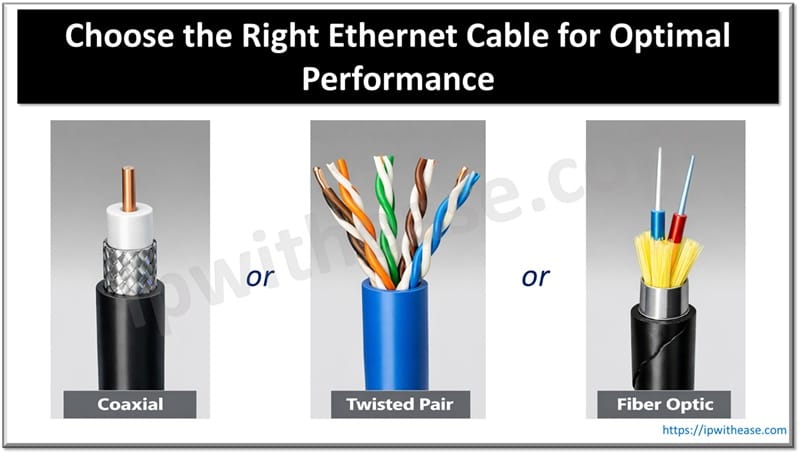
Considering the physical characteristics of the transmission medium, there are three types of Ethernet cables.
Coaxial
Coaxial cables have a simple concept, which is a single copper cable conductor surrounded by metal foil and braided wire shielding just under the outer jacket layer. These cables are no longer used for internet connections because they have major limitations, such as low speeds, shared collision domains, and troubleshooting difficulty. However, you can find them in old installations, and you might remember them if you are an old cookie. Terms like 10Base2 Thinnet and 10Base5 Thicknet might ring a bell.
Twisted Pair
Twisted pair Ethernet cables have become the standard in wired connections for modern networks, and they feature four twisted pairs of thin, insulated copper wires that are all housed in a flexible plastic jacket. Some have a shielding layer (extra plastic, aluminum foil or braided copper) to keep EMI in noisy environments from getting in. The only limitation of data transmission in these copper wire pairs is speed, distance, and interference.
Fiber Optic
Fiber optic Ethernet cables solve the challenges twisted pairs experience because they transmit data as light pulses through heavily cladded glass strands. They come in two flavors.
- Single-Mode Fiber (SMF): These cables have a thin glass strand core that transmits data via only one light path, which is perfect for long distances.
- Multi Mode fiber (MMF): This cable can handle multiple light paths in its thicker glass strand core, making it ideal for high-speed data transmission across short distances, such as in data center backbone linkages.
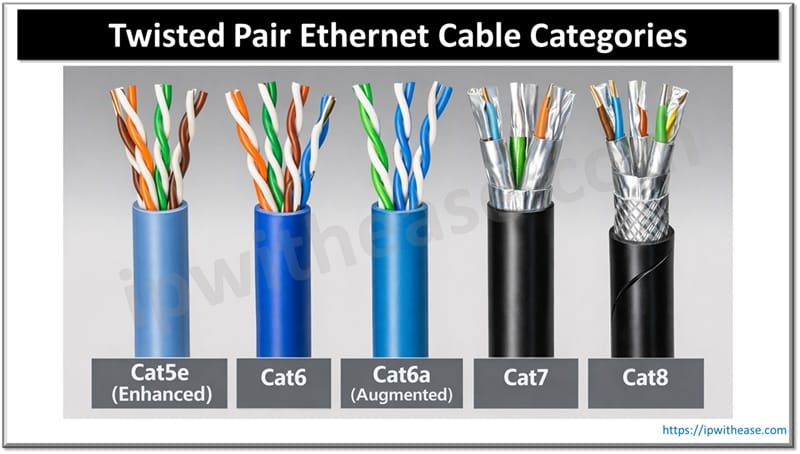
Twisted Pair Ethernet Cable Categories
Twisted pair Ethernet cables dominate modern network connections, and they come in different categories that specify their performance. This type was invented by Alexander Graham Bell in 1881 for telephone networks beginning with Cat1. However, these earlier categories and their subsequent improvements are extremely slow. So we’ll begin with Cat5e because its performance is still relevant in modern networks.
Cat5e (Enhanced)
Although this category has been around since the late 90s, it performs quite well, reaching speeds of 1Gbps at 100MHz bandwidth while covering a distance of up to 100 meters. It is suitable for home and office use, since most of these areas don’t run multi-gigabyte applications. So if users aren’t complaining about slow network speeds, this cable still gets the job done at low cost.
Cat6
Cat6 twisted pair cables were formalized in 2001 and their advancement over Cat5e is in more stringent manufacturing to reduce noise and crosstalk. This included the addition of a plastic spline separator between the twisted pair to minimize crosstalk.
The result was an increase in speeds, reaching up to 10Gbps for distances not exceeding 55 meters and 1Gbps for up to 100 meters, both at a bandwidth of 250MHz. So it only makes sense to upgrade from Cat5e to Cat6 if the distance covered is short. Otherwise, the data transfer speeds will be equal.
Cat6a (Augmented)
This category was defined in 2009 and has proven to be the enterprise sweet spot for balancing performance and cost because it delivers the full 10Gbps transmission speed performance across 100 meters at double the frequency (500MHz). Another advantage over its predecessor is it picks up less alien crosstalk noise at high frequencies.
Cat7
Cat7 is not a fully recognized standard because TIA/EIA has never approved it. However, ISO recognized it, so it is worth mentioning. It only comes in a shielded configuration (each pair is shielded plus with a shared screen) to reduce EMI and crosstalk. This makes it suitable for high-density network installations or noisy industrial applications. While some feature RJ45 connectors, some are terminated using proprietary connectors, limiting compatibility with standard networking equipment.
Performance-wise, you get the same 10Gbps over 100 meters but at a higher bandwidth of 600MHz. However, these cables are an overkill for residential and enterprise users. Cat6a gives better value for money, unless you have a very specific use case that requires extreme noise interference reduction.
Cat8
These cables are thicker than Cat6a and Cat7, costlier, and definitely an overkill for regular enterprise networks. But they are worth the money as compared to Cat7 because they deliver speeds reaching 40Gbps at frequencies of up to 2GHz, albeit for short distances not exceeding 30 meters. This performance means they are the fastest copper Ethernet cables, making them suitable for data center and server room connections, particularly 25G and 40G switch-to-switch connections.
On the physical aspect, besides being thicker, these cables are fully shielded and are terminated using RJ45 connectors, making them backward compatible with Cat6a, Cat6, and Cat5e devices.
How to Choose the Right Ethernet Cable for Your Application
Home Networks
Cat5e is enough for most home networks, including Gigabit Fiber connections. But for gamers, Cat6 or Cat6a are better because they handle multi-gig speeds. Cat6a is also specifically good for future proofing wireless connections because WiFi 7 access points can push up to 5G traffic back to the switch
Cat8 doesn’t make sense for gaming because the game server’s latency or even your internet connection speed might not match.
Enterprise Networks
Cat6a is usually sufficient for most enterprise network installations because it supports 10G at reasonable cost across the entire 100 meters.
Industrial Deployments
Shielding is necessary around industrial machinery, such as motors, because they generate a lot of EMI. Here’s where Cat7 might shine because it will solve the mysterious connectivity issues that might arise and are a nightmare to troubleshoot. If not using twisted pair Ethernet, Fiber optic can work perfectly.
Data Centers
Data centres must have Fiber as the network backbone link coupled with Cat6a or Cat8 for the server and switch connections, depending on the port speed.
Conclusion
Since Ethernet twisted pairs are the most commonly used, it is important to know the performance and recommendation of each one before doing a network installation. Cat7 cables are considered more of proprietary technology, so they are not commonly used, especially if they don’t have the standard RJ45 connectors. But the rest are standard and recognized by TIA/EIA, with Cat6 and Cat6a giving the best value for money for home and enterprise use cases.
ABOUT THE AUTHOR

IPwithease is aimed at sharing knowledge across varied domains like Network, Security, Virtualization, Software, Wireless, etc.