Table of Contents
Systems in a network communicate with each other to exchange information and data. The network is a medium where one can share data and information, can access and receive files, connect external devices such as printers, faxes etc and share them among multiple users over a network. The network interconnections required a set of equipment such as network cables, repeaters, hub, switches, network interface cards (NIC).
The systems in a network can connect in various ways and that is referred to as network topology which dictates the manner in which systems will be interconnected for information and data exchange.
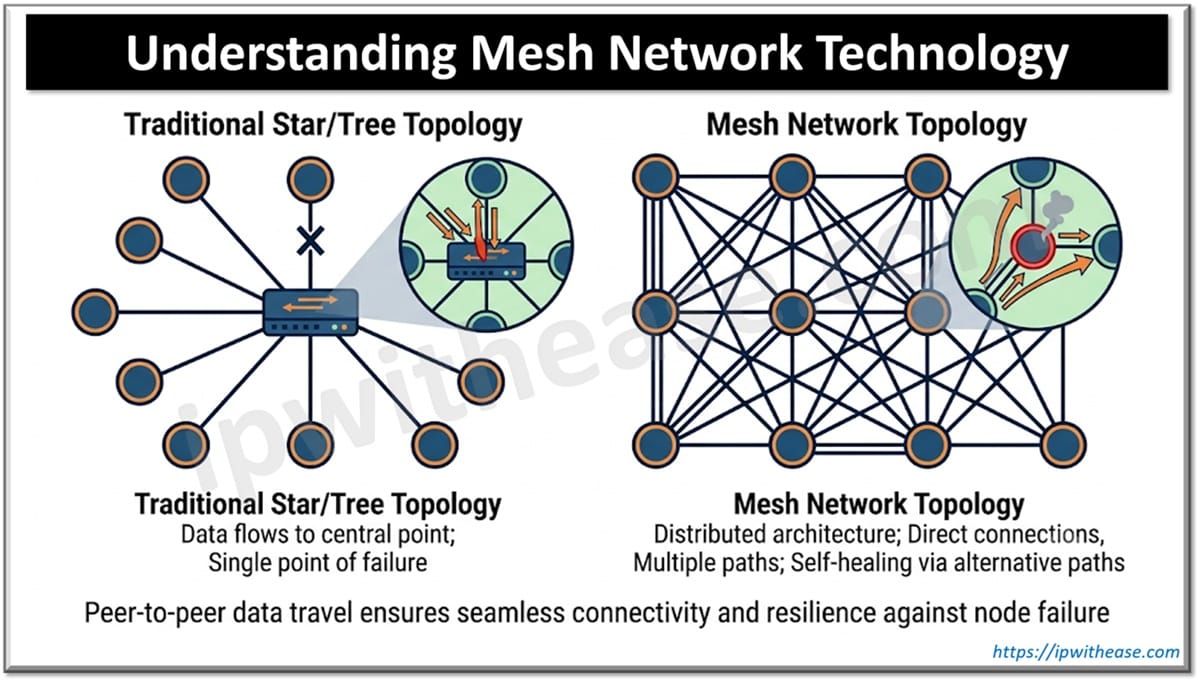
Mesh network technology is a distributed topology where each node directly connects and communicates with other nodes in the network. Widely used in wireless networks for its resiliency and redundancy against network failures.
In today’s article we will learn about Mesh Network technology, its types and benefits and limitations of each one of them.
Mesh Network Technology
In an Ethernet network most widely used topologies are bus, Star and tree or could be combination of them. Here the data flows to a central point and is further sent to the requested node. Mesh networks on the other hand work on distributed topology or architecture. There is a direct connection or peer-to-peer connection between nodes and each node in the network can communicate directly with any other node in the network thus creating multiple paths for data travel. If the event one node is non-functional data will be routed via another node to ensure seamless connectivity.
Types of Mesh Network Technology
Mesh networks are of several types. The different types of mesh networks address the specific requirements.
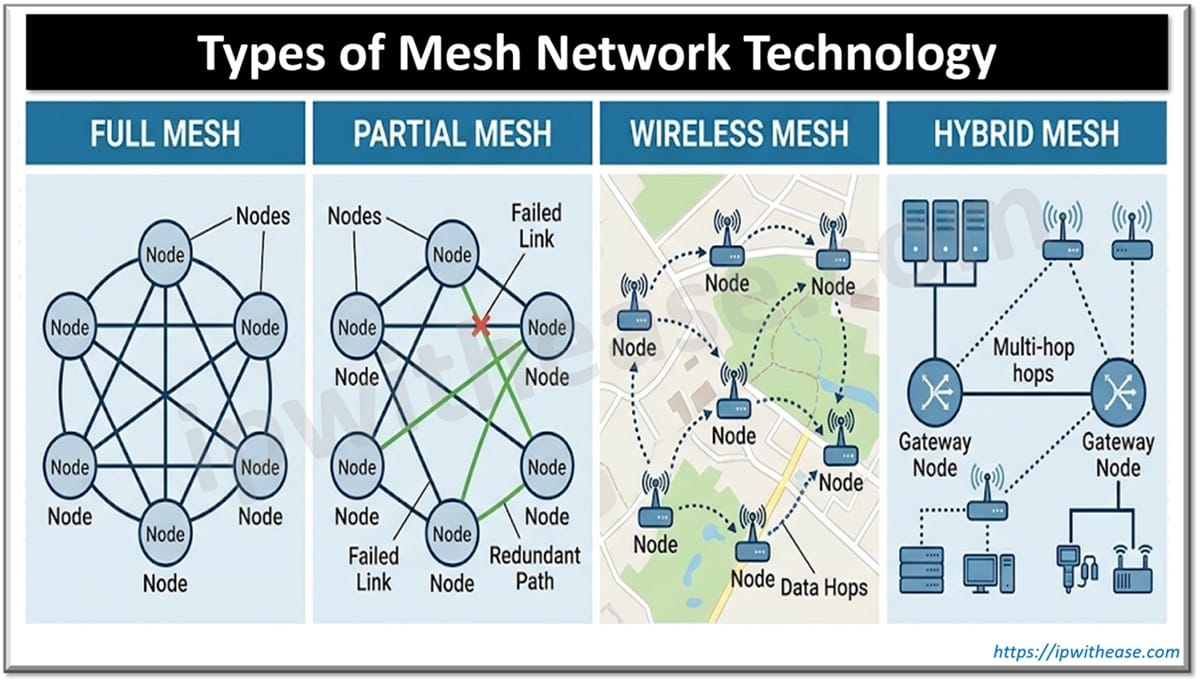
Full Mesh
Every node is connected with every other node in the network and ensures the highest level of resiliency and redundancy. Full mesh networks are not ideal for large setups as the network grows they become costlier and complex to manage efficiently.
Partial Mesh
Partial Mesh is a less costly version of full mesh where not all but certain nodes are connected to few others. This arrangement provides redundancy for critical workloads at a lesser cost and reduction in management complexity. Data is rerouted to alternate path in the event of failure.
Wireless Mesh
It is widely used where laying physical cables is not a preferred option, ideal for outdoor and temporary installations to meet the communication requirements.
Buy – Mesh Wi-Fi for Home, Mesh Wi-Fi for Business
Hybrid Mesh
As the name suggests it is a mix of mesh network technologies and combines both wired and wireless communication connections. This network technology is ideally suited for large industrial environments or big building complexes.
Advantages and Limitations
Advantages
- Mesh networks use dedicated links between nodes thus enabling peer-to-peer connectivity between nodes and data can be transmitted by multiple nodes simultaneously
- If connectivity is lost between two nodes it will not impact data transfer happening via other nodes in the network
- It is easy to add new devices to existing network without impacting the availability or performance of the network due to its distributed architecture
- Messages travel fast as there is a direct connectivity between nodes hence shorter path
- Mesh networks are highly secure and resilient towards virus and other threats
- It is easy to identify and fix it quickly in this setup
- No central hub or device is required to manage the data transfers as it is directly handled by nodes
Limitations
- Since each node is connected to every other node in the network the cabling requirements are quite high here
- These networks are complex to setup and later manage that complexity
- Node reconnection is cumbersome
- Additional hardware is required to create mesh networks
- The power consumption is higher in mesh networks
Examples of Mesh Technologies
- Telephone exchanges regional offices connectivity
- Military organizations use Mesh technologies as it is highly secure
- Wireless networks use mesh technology
- Used by municipal corporations to check street lights, sewage system etc.
- Used to check gas meters by gas and electric companies
Disclaimer: This blog contains affiliate links. If you purchase through these links, we earn a small commission at no extra cost to you, but that is what keeps this blog alive and the helpful content coming your way.
ABOUT THE AUTHOR

You can learn more about her on her linkedin profile – Rashmi Bhardwaj