Table of Contents
The word “token” gets used a lot in tech, and it doesn’t always mean the same thing. In the crypto world, a cryptographic token is a digital asset that sits on top of someone else’s blockchain. In network security, a cryptographic token is usually the thing that proves who you are: a USB security key, a smart card, or a signed string your browser passes to an API. Both rely on the same idea, which is that cryptography makes the token hard to forge and easy to verify.
This article starts with blockchain tokens, covering what they are, how they differ from coins, the main types and how they work. It then looks at the security side of the term, since both meanings come up regularly in interviews and real projects.
Cryptographic Token
A cryptographic token, often just called a crypto token, is a digital asset created on an existing blockchain. Tokens don’t have a blockchain of their own. They live on top of an established chain such as Ethereum, Solana or BNB Chain, and they can be used to make purchases, to trade, to give holders certain rights, or to represent the value or status of a project.
Building on an established chain has two clear benefits. First, the token inherits the security of that network, which already has thousands of nodes validating transactions. Second, it’s far cheaper and quicker than building a new blockchain from scratch, because the project reuses decentralized infrastructure that already exists.
Related: 8 Cryptography Techniques
Features of Cryptographic Tokens
- Built on a secure, existing blockchain. Tokens use the consensus and security of the host chain instead of running their own network.
- Easy and secure payments. Tokens can be sent to anyone with a wallet address, anywhere in the world, without a bank in the middle.
- Used for payments and trading. Many tokens are bought, sold and exchanged on crypto exchanges or used to pay for services inside an app.
- Can represent an asset. A token can stand for almost anything of value, from a share in a fund to a piece of digital art or a loyalty point.
- Lower time and cost. Launching a token takes minutes and a small fee, compared with the time and money needed to build and secure a whole blockchain.
- Programmable. Because a token is a smart contract, rules such as total supply, transfer limits or voting rights can be written directly into its code.
Token vs Coin: What’s the Difference?
People often use “coin” and “token” as if they mean the same thing. They don’t. A coin is the native currency of its own blockchain. Bitcoin is the coin of the Bitcoin network, and Ether is the coin of Ethereum. The network itself is built around it, and it’s what you pay transaction fees with.
A token, on the other hand, borrows an existing chain. Someone writes a smart contract on Ethereum (or another chain), and that contract keeps track of who owns how many tokens. The token holder still needs some of the underlying coin to pay fees when moving tokens around.
| Coin | Token | |
| Blockchain | Has its own | Runs on an existing chain |
| Created by | The network’s protocol | A smart contract |
| Main purpose | Pays for the network, stores value | Utility, governance, assets, rewards and more |
| Transaction fees | Paid in the coin itself | Usually paid in the host chain’s coin |
| Examples | BTC, ETH, SOL | USDC, UNI, LINK, most NFTs |
How Tokens Are Created: Smart Contracts and Token Standards
A token is really just a smart contract, a small program deployed to the blockchain. At its simplest, the contract holds a ledger of addresses and balances, plus a handful of functions to move balances from one address to another.
If every project wrote these contracts its own way, wallets and exchanges would need custom code for each one. Token standards solve that. They define a common set of functions, so any wallet that supports the standard can hold any token built on it. The common ones are:
| Standard | Chain | What it’s used for |
| ERC-20 | Ethereum and compatible chains | Fungible tokens: stablecoins, utility and governance tokens |
| ERC-721 | Ethereum | Non-fungible tokens, where every token is unique |
| ERC-1155 | Ethereum | Fungible and non-fungible items in one contract, common in gaming |
| BEP-20 | BNB Chain | BNB Chain’s equivalent of ERC-20 |
| SPL | Solana | Solana’s token program, for fungible and non-fungible tokens |
| TRC-20 | TRON | TRON’s equivalent of ERC-20, widely used for stablecoin transfers |
This is also why the same stablecoin can exist on several chains at once. USDC on Ethereum and USDC on Solana are two different contracts issued by the same company, and they aren’t interchangeable unless you go through an exchange or a bridge.
Types of Cryptographic Tokens
Before getting into the individual types, it helps to split tokens into two groups. Fungible tokens are interchangeable, the same way one ₹100 note is as good as another. Any one USDC is worth exactly the same as any other USDC. Non-fungible tokens are unique. Each one has its own ID and can carry its own data, such as a link to a piece of artwork, a ticket seat number or an in-game item. Most of the types below are fungible; NFTs are the exception.
- Utility tokens – are used to grant access to users to access specific services. For example, a digital voucher created to redeem discounts for customers then utility tokens are created.
- Payment tokens – are also known as coins and they are used for making payments instead of physical hard currency. Such as Bitcoin which is a digital currency used in blockchain and speeds up cross-border transactions and reduces govt control over trade and makes the entire process simple by bypassing third party intermediaries.
Security tokens – are like traditional securities. And they are also known as equity tokens just like shares for company stocks. - Defi tokens – means decentralized finance. It uses a protocol meant to create a new financial system similar to the traditional financing system of saving, lending, trading etc and used in block chain technology.
- Crypto rewards – Defi platforms use their own official currency and rely on investors to lend out crypto funds available to borrow. Investors gain profits paid as crypto rewards.
- Governance tokens – are specialized Defi tokens which give holders voting rights.
- Non-fungible tokens – are tokens used by blockchain technology and are cryptographic assets and associated with digital assets such as videos, photos, Audio and art etc.
How do Cryptographic tokens work?
From a user’s point of view, a token goes through four broad stages:
- Development. A project writes and deploys the token’s smart contract on a chosen blockchain, deciding things like name, symbol, total supply and rules.
- Listing. The token is made available for trading on centralized or decentralized exchanges so people can buy it.
- Buying and selling. Users trade the token for other tokens, coins or local currency, and use it within the project’s ecosystem.
- Storage. Tokens are held in a digital wallet. The wallet uses a public key, which acts like an account address others can send to, and a private key, which signs transactions and proves ownership.
The Other Meaning: Cryptographic Tokens in Network Security
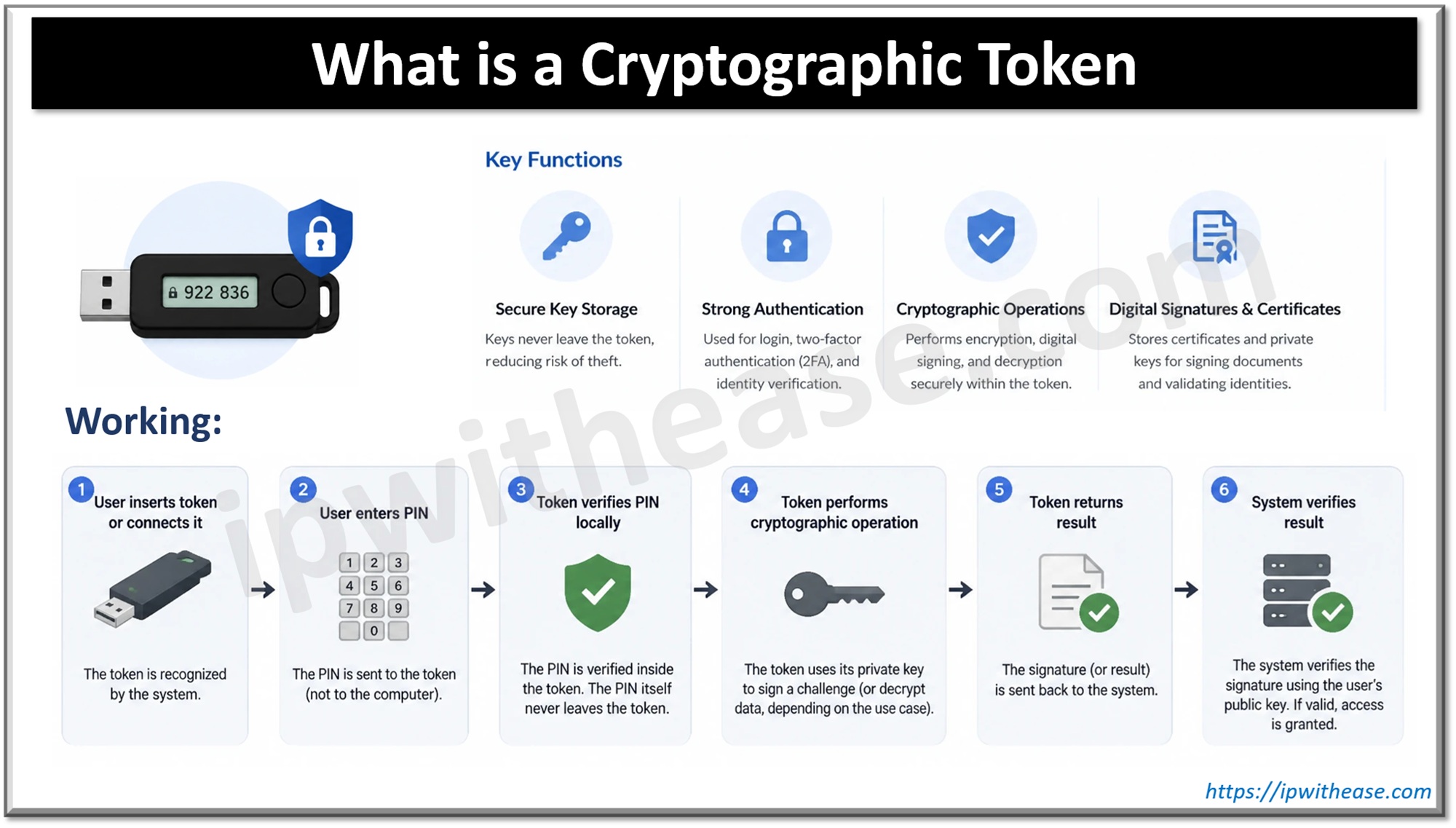
If you work in networking or security, you’ve probably heard “cryptographic token” used in a completely different sense. Here, a token is something that holds or proves a cryptographic secret so a user, device or service can authenticate. The PKCS#11 standard, which defines how software talks to hardware crypto devices, literally refers to these devices as cryptographic tokens.
They fall into two broad families.
Hardware tokens
Hardware tokens keep private keys inside a tamper-resistant chip. The key never leaves the device, so even if the laptop it’s plugged into is compromised, the attacker can’t copy it.
- Smart cards and USB tokens store certificates for login, VPN access, email signing and disk encryption.
- FIDO2 / WebAuthn security keys (YubiKey and similar) provide phishing-resistant MFA, because the key checks the website’s domain before it signs anything.
- OTP tokens generate a one-time code every 30 or 60 seconds, the older style of two-factor login.
- HSMs and TPMs are the server and motherboard equivalents. HSMs guard CA keys, payment keys and code-signing keys in data centers, while a TPM anchors device identity and secure boot.
Software tokens
Software tokens are signed pieces of data rather than physical objects.
- JWTs (JSON Web Tokens) have three parts: a header, a payload of claims such as user ID and expiry, and a signature. The API checks the signature and trusts the claims without a database lookup.
- OAuth 2.0 access and refresh tokens let an app call an API on a user’s behalf without ever seeing their password.
- SAML assertions are signed XML documents an identity provider sends to an application to confirm a user has logged in, common in enterprise SSO.
- Authenticator app codes (TOTP) are the software version of an OTP hardware token.
| Blockchain token | Authentication token (hardware or software) | |
| What it represents | Value, rights or an asset | Identity or permission |
| Where it lives | On a public blockchain | On a device, in a chip, or passed in an HTTP header |
| Role of cryptography | Signs transactions, secures the ledger | Proves the holder is who they claim |
| Typical lifetime | Indefinite | Minutes to years, often short-lived |
| If stolen | Assets can be moved irreversibly | Attacker can impersonate until revoked or expired |
The common thread is the private key. Whether it moves a balance on Ethereum or signs a login challenge for an enterprise identity provider, whoever controls the key controls the token.
Conclusion
Cryptographic tokens have become one of the most flexible building blocks in tech. On blockchains, they let anyone represent money, rights or ownership without building a new network from scratch. In security, they give users and systems a way to prove identity that is far stronger than a password. The details differ, but the principle is the same in both worlds: the token is only as trustworthy as the key behind it, and protecting that key is what really matters.
Frequently Asked Questions
Is a cryptographic token the same as a cryptocurrency?
Not exactly. A cryptocurrency coin like Bitcoin has its own blockchain. A token is built on top of an existing blockchain through a smart contract. Both are digital assets, but they’re created differently.
Can anyone create a token?
Yes. On chains like Ethereum, BNB Chain or Solana, anyone can deploy a token contract in a few minutes for a small fee. That’s exactly why checking the contract address and the team behind a token matters.
What is an ERC-20 token?
It’s a token that follows the ERC-20 standard on Ethereum. The standard defines functions like transfer, balanceOf and approve, so every wallet and exchange can handle it the same way.
Are NFTs cryptographic tokens?
Yes. NFTs are non-fungible tokens, usually built on standards such as ERC-721 or ERC-1155. Each one is unique and can’t be swapped one-for-one with another.
What is a cryptographic token in network security?
It’s a hardware device or signed piece of data used for authentication. Examples include smart cards, FIDO2 security keys, HSMs, JWTs and OAuth access tokens.
What happens if I lose my wallet’s private key?
The tokens stay on the blockchain, but you can no longer move them. Unless you have a backup of your seed phrase, they are effectively lost.
ABOUT THE AUTHOR

You can learn more about her on her linkedin profile – Rashmi Bhardwaj