Table of Contents
Enterprise IT is under pressure from all sides. Systems keep growing more complex, incidents happen at 2 a.m., and the old playbook stopped working somewhere around 2022. AI-driven operations aren’t a trend at this point. They’re the infrastructure layer organizations are quietly building while competitors are still writing RFPs. This piece covers what AI enterprise operations actually means in practice, which use cases are delivering measurable results right now, and where the market is heading through the rest of 2026.
What the Market Looks Like Right Now
Agentic AI in IT operations evolved through several generations of tooling — from basic AIOps dashboards like Splunk and Dynatrace to LLM-powered assistants plugged into ITSM workflows. But 2025–2026 marks a real shift: platforms are moving from alert aggregation toward autonomous decision-making. Not “here’s an anomaly” but “here’s what we did about it.”
One platform worth noting is DXC Technology’s orchestration layer for mission-critical environments (more on the capabilities can be found at https://dxc.com/platforms/dxc-oasis).
The positioning is around what they call human+ agentic operations: AI agents handle the high-volume, repetitive decision layer while engineers stay in the loop for judgment calls that actually matter.
Rather than replacing existing monitoring stacks, this integration-agnostic approach sits above tools an enterprise already uses — connecting ServiceNow, cloud telemetry, network monitoring, mainframe health checks — into a single orchestration layer. No rip-and-replace. Just coherent orchestration where there used to be fragmented noise.
Prototypes and Test Deployments Worth Watching
The pace of experimentation accelerated noticeably in late 2025. Some things being tested in real environments right now:
- Multi-agent incident response: Multiple specialized AI agents (one for log analysis, one for network topology, one for change management) collaborating to resolve P1 incidents without human escalation. Early pilots at financial services firms report resolution times cut by 60–70%.
- LLM-powered runbook automation: Microsoft’s integration of Azure OpenAI into their IT Operations suite means runbooks can now be executed conversationally — an on-call engineer describes a symptom, the system maps it to a resolution path, and executes with full audit logs.
- Predictive capacity planning: Siemens is running AI-driven digital twins of production environments where the operations layer pre-negotiates cloud burst capacity based on predicted demand spikes, sometimes 72 hours ahead.
- Autonomous patch management: ServiceNow’s Vancouver release introduced AI agents that assess patch risk scores, test in sandbox, and schedule deployment windows without human initiation.
The common thread: less watching, more doing. The industry’s vocabulary is shifting from “observability” to “autonomous remediation.”
Core Benefits of AI Enterprise Operations
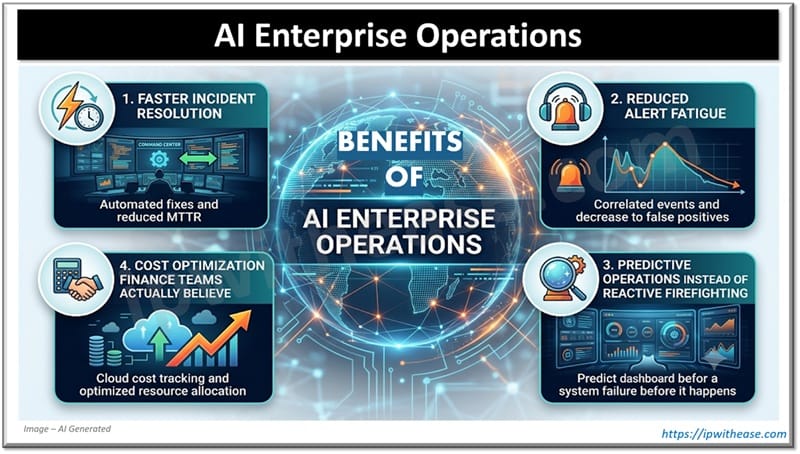
1. Faster Incident Resolution
Mean Time to Resolve (MTTR) is the metric everyone has tracked for decades and struggled to actually improve. AI changes the dynamics because it correlates signals across systems faster than any human team.
Real-world scenario: a banking application showing latency spikes. Traditional workflow — alert fires, engineer gets paged, reviews dashboards across five tools, identifies root cause, implements fix. Total elapsed time: 45 minutes on a good day, three hours on a bad one.
With an AI operations layer, the system sees the latency spike, cross-references it with a deployment that happened 12 minutes ago, identifies a misconfigured timeout parameter, and either auto-remediates or hands off to an engineer with a ready-to-execute fix. MTTR: under 8 minutes in documented pilot cases at tier-1 financial institutions.
2. Reduced Alert Fatigue
The average enterprise IT environment generates 2,000–10,000 alerts per day. Most are noise. Some are the early signal of an outage that costs $500,000 per hour.
AI operations platforms address this with noise suppression at the source — correlating alerts into meaningful incident clusters. Instead of 2,000 individual notifications, on-call engineers see 15 grouped incidents with priority scores and suggested owners.
What operators typically report after 90 days:
- Alert volume down 70–85% after tuning
- False positive rate drops from ~40% to under 8%
- After-hours escalations cut in half within the first quarter
- Engineer on-call burnout measurably reduced — which shows up in retention metrics
3. Predictive Operations Instead of Reactive Firefighting
Most IT operations are reactive — something breaks, you fix it. AI shifts the model toward prediction.
What predictive operations looks like in practice:
- Disk failure forecasting: ML models trained on SMART data patterns predict drive failures 2–7 days before they happen. Storage teams running render farms for VFX pipelines have used this to reduce unplanned downtime by ~80%.
- Application performance degradation: AI models identify patterns that precede slowdowns — memory pressure building over hours, GC cycles lengthening — and trigger scaling actions before users notice anything.
- Security operations: Darktrace’s self-learning AI, used by enterprises like Rolls-Royce and McLaren, detects behavioral anomalies that don’t match any known threat signature. It caught a novel attack vector at a UK financial firm 11 days before human analysts would have flagged it manually.
4. Cost Optimization Finance Teams Actually Believe
Cloud cost optimization is a compelling case. Tools like IBM Turbonomic’s autonomous resource management and Apptio Cloudability with ML-driven anomaly detection have documented cost reductions of 20–35% in cloud spend for enterprises that implement them properly.
“Properly” matters. The enterprises seeing 35% reductions spent six months tuning models and integrating their tagging strategy. The ones who turned it on and expected magic in week two typically see 8–12%.
AI Enterprise Operations: Real-World Use Cases Across Industries
Financial Services
Banks were early adopters — not because they’re progressive, but because their downtime costs are catastrophic. JPMorgan Chase’s COiN program processes millions of internal signals daily. Deutsche Bank’s operations center runs AI-driven correlation tools across their European trading infrastructure, where MiFID II compliance requires detailed audit trails that AI-native platforms generate automatically.
Manufacturing
An automotive plant running 24/7 production can lose $1.3 million per hour during an unplanned line stop. Foxconn, manufacturing for Apple and dozens of other companies, has deployed AI operations tooling across production environments — monitoring thousands of sensor feeds, correlating anomalies, predicting equipment failures before they cascade.
Healthcare
Healthcare IT runs under three simultaneous pressures: HIPAA compliance, near-zero downtime requirements for clinical systems, and a massive ransomware target surface. Epic Systems, deployed at Mayo Clinic and Cleveland Clinic, now has integration pathways with AI operations tooling that didn’t exist two years ago.
What Doesn’t Work Yet
Honest conversation requires acknowledging where AI operations tooling still fails:
- Complex multi-vendor environments with inconsistent telemetry are still hard to orchestrate. Garbage in, garbage out applies aggressively here.
- Change management is the real blocker. Engineers who’ve spent 15 years building institutional knowledge about a system are understandably cautious about AI agents making autonomous changes in production.
- Cold start problem: Organizations with immature observability — limited historical incident data, inconsistent logging — can’t unlock predictive value immediately. Expect 6–12 months before models become useful.
The enterprises succeeding here tend to be the ones that treated AI operations as an engineering discipline, not a product purchase.
What to Watch Through the Rest of 2026
- Anthropic’s enterprise partnerships are expanding into operations contexts. DXC’s multi-year alliance with Anthropic (announced June 2026) focuses on bringing Claude-based agents into mission-critical enterprise systems — worth watching as a template for how foundation model providers integrate into operations tooling.
- Platform consolidation is happening fast. ServiceNow, Microsoft, and Salesforce are all building AI operations capabilities into existing platforms, which will pressure standalone AIOps vendors.
- Regulatory frameworks for autonomous operations AI are in development across the EU and UK. Enterprise legal teams should be paying attention now, not when the regulation lands.
The Bottom Line
The shift happening in enterprise IT operations isn’t subtle if you’re inside it. The systems managing critical infrastructure for airlines, banks, manufacturers, and hospitals are quietly becoming self-healing — not recklessly, not fully autonomously, but meaningfully so in ways that would have seemed far-fetched five years ago.
Whether that’s exciting or unsettling probably depends on where you sit in the organization. For the engineer getting paged at 3 a.m. over something an AI could have caught and fixed two hours earlier — mostly exciting.
ABOUT THE AUTHOR

IPwithease is aimed at sharing knowledge across varied domains like Network, Security, Virtualization, Software, Wireless, etc.