Table of Contents
Every enterprise that encrypts data today is quietly making a bet: that the encryption will still hold by the time anyone with a powerful enough computer gets around to breaking it.
That bet is getting worse by the year. A 2025 poll of technology professionals found that most worry quantum computing will eventually break current encryption, yet almost none work somewhere with an actual plan to respond.
Post-quantum cryptography closes that gap. It runs as software, not specialized hardware, which means most enterprises can start migrating with the infrastructure they already own. Here is why waiting is no longer a defensible strategy.
Key Takeaways
- Post-quantum cryptography uses new algorithms designed to resist both classical and quantum computer attacks.
- NIST finalized its first three post-quantum standards in August 2024, ready for enterprise deployment now.
- Harvest now, decrypted later attacks make today’s encrypted traffic a target well before quantum computers mature.
- Only a small fraction of organizations report having a defined quantum readiness strategy despite widespread concern.
- Crypto agility, not a one time swap, is what lets enterprises adapt as standards keep evolving.
What Is Post-Quantum Cryptography?
Post-quantum cryptography is a set of encryption algorithms built to resist attacks from quantum computers as well as ordinary ones. Unlike quantum key distribution, which needs specialized hardware and dedicated fiber, PQC runs entirely in software.
Classical algorithms like RSA rely on math problems, such as factoring huge numbers, that take ordinary computers an impractical amount of time to solve. Learning how post-quantum cryptography works shows why the fix does not require new equipment: instead of factoring, PQC leans on different math problems that resist both classical and quantum attacks, and it deploys as a software update rather than a hardware rollout.
Quick Definition: PQC and quantum key distribution both defend against quantum threats, but PQC is software based and works on existing infrastructure, while QKD needs dedicated fiber and specialized photon hardware.
Why Classical Encryption Is Running Out of Time
Encryption strength used to be measured in decades. That clock is compressing fast.
In 2019, researchers estimated that cracking RSA encryption would require roughly 20 million stable qubits. By 2025, that estimate had dropped under 1 million, and early 2026 research suggests certain conditions could push it as low as 100,000 qubits.
No cryptographically relevant quantum computer exists yet. The trend line only moves one direction, and enterprises whose records must remain private for years cannot wait for certainty before acting.
The Enterprise Readiness Gap
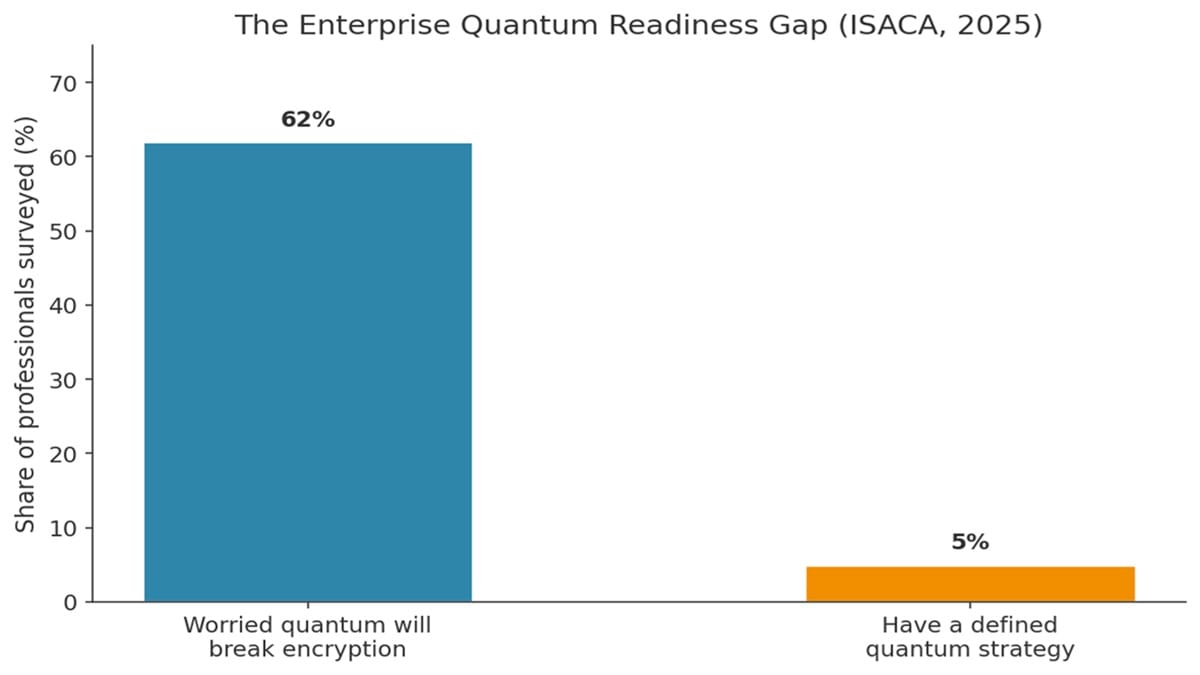
The gap between concern and action is stark. ISACA surveyed more than 2,600 professionals across digital trust, audit, and cybersecurity roles and found the exact imbalance shown above, detailed in the survey’s full findings.
Many teams that have already tightened zero trust access controls for cloud workloads are best positioned to extend that same discipline to cryptography, since both problems come down to reducing implicit trust across the network.
NIST’s Finalized Post-Quantum Standards
After a multi year evaluation involving researchers from dozens of countries, NIST finalized three quantum-resistant standards in August 2024.
| Standard | FIPS Number | Algorithm Family | Primary Use Case |
|---|---|---|---|
| ML-KEM | FIPS 203 | Lattice based | Key establishment |
| ML-DSA | FIPS 204 | Lattice based | Digital signatures |
| SLH-DSA | FIPS 205 | Hash based | Digital signatures |
These three form the foundation most enterprises will build on first. NIST’s finalized federal encryption standards specify exactly how each algorithm should be implemented, which removes much of the guesswork that used to slow vendor adoption.
NIST evaluated 82 candidate algorithms from 25 countries before settling on its three finalized standards.
How Harvest Now, Decrypt Later Changes the Risk Calculus
Attackers do not need a working quantum computer today to profit from your encryption. They can copy encrypted traffic now and simply wait, an approach researchers call harvest now, decrypt later.
| Warning: Legal communications, merger records, pharmaceutical research, and government contracts often carry confidentiality requirements measured in decades. That is exactly the data attackers are collecting today for decryption once quantum computers mature. |
A document your legal team sent last week, protected with standard encryption, could already be sitting in an adversary’s storage. The exposure has already happened. Only the decryption is waiting on hardware.
Regulatory and Compliance Pressure Is Already Building
The US National Security Agency has set deadlines through its Commercial National Security Algorithm Suite 2.0 guidance, and enterprises selling into regulated sectors will feel the ripple effect long before their own deadline arrives.
| System Type | Prefer By | Exclusive Use By |
|---|---|---|
| Software and firmware signing | 2025 | 2030 |
| Browsers, servers, cloud services | 2025 | 2033 |
| VPNs and networking equipment | 2026 | 2030 |
Vendors serving government or defense customers are already required to plan around these dates, and that pressure cascades down through every supplier in the chain.
Building a Crypto-Agile Migration Plan
A one time algorithm swap will not be enough. Standards will keep evolving, so the architecture matters as much as the algorithm.
- Inventory every cryptographic dependency across applications, certificates, and third party services.
- Prioritize systems holding records with long term sensitivity, not just short lived transactions.
- Test hybrid deployments that run classical and post-quantum algorithms side by side.
- Build architecture that swaps algorithms without a full system rebuild.
- Confirm vendors and partners are on their own migration timeline before yours arrives.
| Pro Tip: Crypto agility means avoiding hardcoded cryptographic primitives. Systems built to swap algorithms through configuration, not code changes, absorb future NIST updates far more cheaply. |
IT and security teams often coordinate this inventory work across distributed offices and data centers using remote support platforms, so it is worth confirming those tools already meet current encryption and compliance standards for remote access software before folding them into the migration plan.
Enterprises already running SASE architecture across distributed offices often find it easier to layer in post quantum key exchange, since the security stack was already built for centralized updates rather than device by device patching.
Where Enterprises Should Start
Industries holding the most sensitive, longest lived data are moving first.
- Banking and financial services: transaction records and account data need protection well beyond a typical retention window.
- Healthcare: patient records carry regulatory requirements that outlast most hardware refresh cycles.
- Government and defense: classified and controlled information faces the clearest compliance deadlines today.
- Cloud and infrastructure providers: a single unmigrated platform can leave every downstream customer exposed.
Teams evaluating zero trust network access to replace legacy VPNs should fold cryptographic inventory into that same modernization project rather than treating it as a separate initiative later.
What Slows PQC Adoption Down
A few practical hurdles explain why migration takes years rather than months.
- Larger keys and signatures: post-quantum algorithms often need more bandwidth and storage than classical ones.
- Legacy hardware: older devices sometimes cannot support new algorithms without a firmware or full replacement.
- Interoperability: mismatched algorithm support between vendors can break existing integrations mid migration.
Organizations mapping out the networking features needed for a secure cloud transition should add cryptographic agility to that checklist from day one, rather than bolting it on after the rest of the architecture is set.
FAQs
Q.1 What is post-quantum cryptography in simple terms?
Post-quantum cryptography is a set of encryption algorithms designed to stay secure even against a powerful future quantum computer. It replaces the math problems that quantum machines could solve quickly with different problems that remain hard for both types of computers.
Q.2 Do enterprises need to act before quantum computers exist?
Yes. Harvest now, decrypt later attacks mean encrypted data is being collected today for future decryption. Waiting until a capable quantum computer exists means the exposure already happened years earlier.
Q.3 Is post-quantum cryptography the same as quantum key distribution?
No. PQC is software that runs on existing hardware and protects against quantum threats through new algorithms. Quantum key distribution uses the physics of light and needs specialized equipment, making it far less practical for general enterprise use.
Q.4 How long does a PQC migration typically take?
Most enterprise migrations span multiple years rather than months, since cryptography is embedded across applications, certificates, and vendor systems. A phased, crypto agile approach spreads that work without disrupting operations.
Q.5 Which systems should be prioritized first?
Start with systems that hold records needing long term confidentiality, such as financial data, health records, and government contracts. These carry the highest exposure to harvest now, and decrypt later attacks.
Conclusion
Post-quantum cryptography is no longer a research topic. Standards are finalized, deadlines are published, and the data being harvested today gives attackers a reason to wait rather than a reason to stop.
Enterprises that begin migrating now, methodically and with crypto agility built in, will treat this as a managed project. Those that wait will eventually face it as an emergency, on someone else’s timeline.
ABOUT THE AUTHOR

IPwithease is aimed at sharing knowledge across varied domains like Network, Security, Virtualization, Software, Wireless, etc.