Table of Contents
For modern organizations, it is common to face complex cybersecurity risks that affect their overall IT infrastructure. As a result of such risks becoming impossible to prevent through perimeter security controls alone, companies must find ways to consolidate log data, detect anomalous behavior quickly, and isolate incidents before they spread. Security Info and Event Management (SIEM) systems provide the technical framework necessary to address these challenges.
This article analyzes how SIEM platforms enable teams to accelerate detection through correlation, address visibility gaps, and streamline systematic threat response.
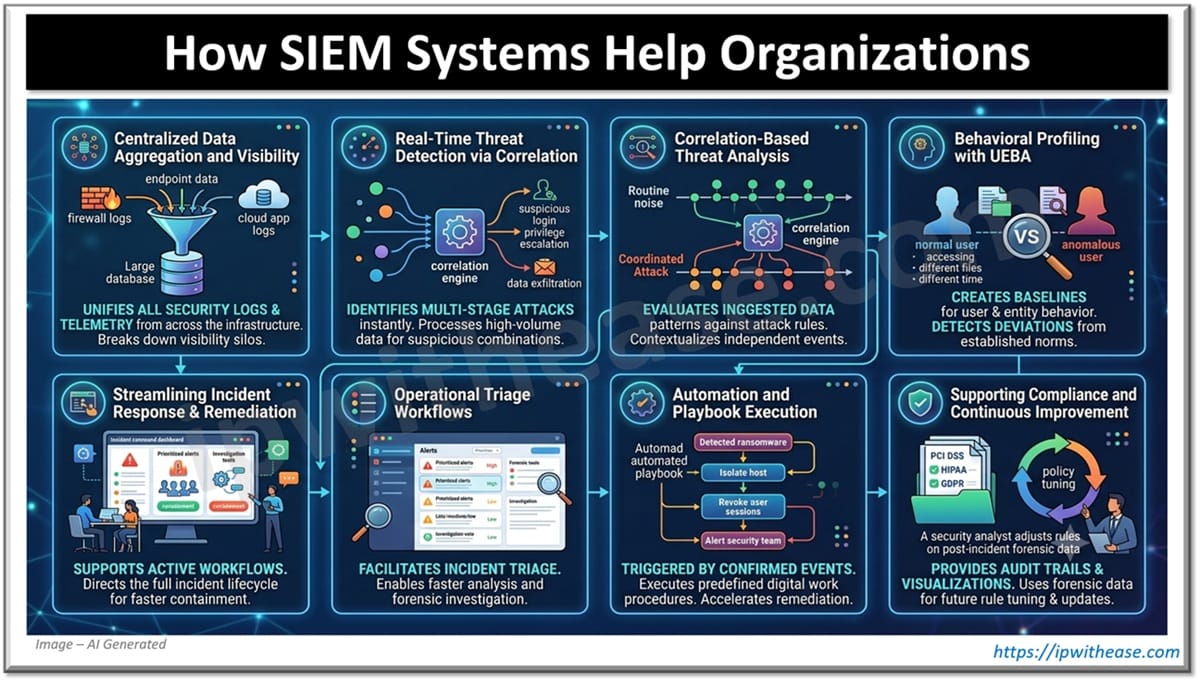
How SIEM Systems Help Organizations
Centralized Data Aggregation and Visibility
In many companies, security telemetry tends to be compartmentalized within endpoints, network appliances, and separate cloud environments. This creates visibility gaps that weaken security defenses. If signs of compromise appear in separate firewall and OS (operating system) event logs, security analysts will have to switch between several administration interfaces to correlate the events. Such processes will give threat actors enough time to maintain their presence in the system or transfer the unauthorized data.
The main feature of the SEIM is its ability to collect log information coming from different systems. To do so, the platform uses agents, connectors, API integrations, Syslog feeds, and other data ingestion methods. Since events across different systems are recorded in very different formats, simple data ingestion is not enough. That is why the SIEM platforms normalize this data.
Real-Time Threat Detection via Correlation
The gathering of raw logs can be seen as just the first step towards securing security monitoring. Companies tend to deal with a large number of low-quality alerts provided by stand-alone point products.
These constant incoming alerts without context result in alert fatigue and make it difficult for an organization’s staff to notice the sign of a compromised system. The use of correlation engines, analytics, and sometimes machine learning makes SIEM solutions solve this problem.
Correlation-Based Threat Analysis
Correlation engines evaluate ingested data streams based on predefined analysis policies to detect multi-stage malicious patterns that traverse multiple layers of the infrastructure. For instance, failed login attempts from an uncommon IP address can be treated as routine authentication noise, and a successful login followed by access to any sensitive systems can be treated as another independent event.
But using a SIEM solution, both events can be correlated and identified chronologically as potential credential stuffing or account takeover.
Behavioral Profiling with UEBA
Most platforms take advantage of behavioral analytics, more precisely the User and Entity Behavior Analytics (UEBA), to establish baseline behavior patterns for user identities, hosts, applications, IP addresses, and devices inside the network. The SIEM solution detects when a trusted identity begins to behave unexpectedly, such as by accessing restricted files outside normal business hours.
With this approach, all related alerts and anomalies are consolidated into a single incident case, enabling security professionals to filter out noise and investigate only the risks confirmed by actual incidents.
Streamlining Incident Response and Remediation
When a validated threat pattern matches a configured analytic rule, SIEM platforms with incident management and SOAR capabilities can support active incident response workflows.
Operational Triage Workflows
For companies with a small number of security personnel, the speed of this transition can influence the magnitude of the subsequent containment operation. Time taken for the first step of the initial containment phase allows malware to gain unauthorized access and expand across the infrastructure.
The SIEM solution may also offer specific user interfaces that facilitate triage and forensic investigation workflows. In many cases, an incident review dashboard can be used to collect and prioritize notable events according to calculated urgency levels.
Automation and Playbook Execution
To enhance remediation processes and efficiency, many contemporary SIEM systems feature Security Orchestration, Automation, and Response (SOAR) capabilities. Automated actions are based on predefined digital work procedures known as playbooks, which are triggered once an event is confirmed.
If the endpoint device shows behavior consistent with a ransomware attack, a suitable SIEM system with proper integration of SOAR and the necessary permissions can be triggered using a specific playbook. In such a scenario, this playbook can be used to direct the endpoint protection system to disconnect the endpoint device from the local network, de-authorize the cloud applications currently logged in, and alert the on-duty security personnel about the issue.
Supporting Compliance and Continuous Improvement
Beyond immediate tactical remediation, SIEM technology addresses long-term strategic requirements for organizations, particularly regarding regulatory compliance and forensic auditing. Many industry standards and regulations, such as PCI DSS, HIPAA, and GDPR, make centralized logging and auditability important, although the exact monitoring and retention requirements vary by framework.
A SIEM solution could assist in the efficient execution of regulatory audits and post-incident forensics investigations due to centralization and configurability of log storage. The administrators would be able to utilize the built-in visualization tools to create audit trails of network activity and configuration changes.
Analysts can use archived telemetry to trace an exploit, isolate entry vectors, and identify underlying vulnerabilities. This evidence enables engineering teams to fine-tune correlation rules and update automated playbooks to help reduce the likelihood of similar future compromises.
Conclusion
Security incident management in a decentralized infrastructure is problematic since disparate solutions lack visibility, which can be exploited by malicious parties. SIEM systems solve such problems structurally by collecting data from distributed sources, performing threat correlation in real-time, and managing remediation procedures in one pane.
With a centralized system in place, security staff inside an organization will be able to detect complex threats early and carry out actions aimed at containing them.
ABOUT THE AUTHOR

IPwithease is aimed at sharing knowledge across varied domains like Network, Security, Virtualization, Software, Wireless, etc.