Table of Contents
AI Security refers to the practices, frameworks, and technologies used to protect AI systems – including their models, data, and infrastructure from threats like adversarial attacks, data poisoning, model theft, and unauthorized manipulation of outputs. It also encompasses ensuring AI systems behave safely, ethically, and reliably, covering aspects like data privacy, model robustness, and governance throughout the AI lifecycle.
The AI adoption is on a top gear across enterprises and its expansion has brought with itself both benefits and challenges. AI is becoming an integral part of the business decision making process but since AI has lesser or no human intervention it has brought with us a new set of challenges and risks. The AI era landscape challenges cannot be overcome with traditional approaches to cyber security. Gone are the days when patches, hardening and other security controls were applied periodically, tested occasionally.
The traditional cybersecurity focused on network, systems and data protection. But AI risks are unique and very different from the traditional risks. The AI security calls for protection of both underlying infrastructure and AI and machine learning lifecycle. Threats such as prompt injection, model poisoning, manipulation, data poisoning have emerged which bypass the existing defences.
In today’s article we understand what are key threats or risks to AI PODs, what are the best practices to secure AI workloads.
Why does AI Security matter now?
AI risks are very different from the traditional threats and as more and more systems and enterprise data is moving into AI it is expanding the threat surface. Like when cloud penetration had begun, the risk of Shadow IT had emerged in the AI landscape, shadow AI risk emerged. The organizations are not aware or know if they have visibility into all AI services they are running and what all is exposed in their environment which is now a blind spot and a golden opportunity for attackers to exploit.
Along with that, regulatory pressures are also building up regulations such as AI EU ACT and global data protection laws (CCPA and GDPR) mandating more compliance requirements while handling AI usage especially when there is a high risk of sensitive data exposure.
The New AI Attack Surface
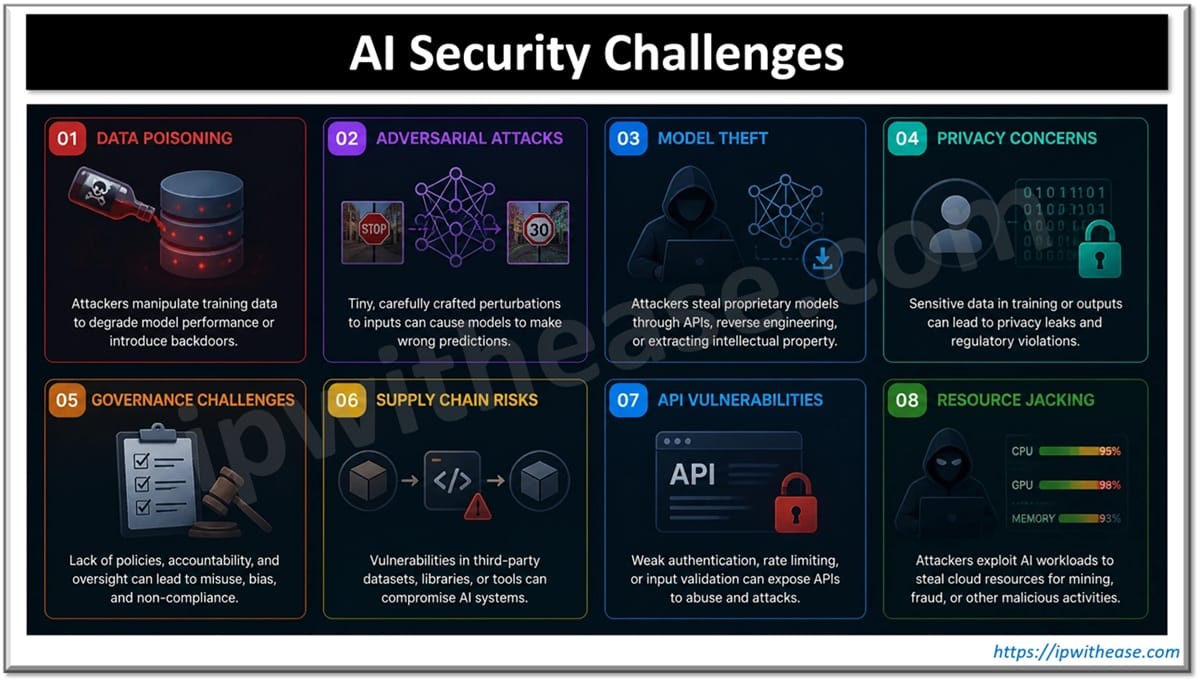
AI has introduced a new set of risks which hackers are already exploiting. Let’s look into them in more detail in this section.
- Data Poisoning – Malicious code is injected into AI systems training pipeline which compromises the model reliability and integrity. This risk could create havoc by introducing new vulnerabilities or manipulating predictions.
- Adversarial Attacks – tricks an AI system which lead to wrong decision making. This kind of manipulation in regulated industries such as healthcare and autonomous vehicles have serious impact in terms of loss of human lives or tragedy.
- Model Theft – API abuse and reverse engineering techniques are used to replicate or extract proprietary models. This could lead to model misuse and loss of intellectual property.
- Privacy Concerns – In advert exposure to personally identifiable or sensitive personal information via model output or due to residual training data patterns could occur.
- Governance Challenges – Opaqueness of AI models makes it challenging to audit decisions taken by AI and establish accountability of actions. This could lead to ethical and regulatory issues.
- Supply Chain Risks – Third party tools and solutions being used in AI systems open another door to potential vulnerabilities. Dependencies can be corrupted or compromised and backdoors can be embedded.
- API Vulnerabilities – Lack of strong authentication, encryption and monitoring of APIs could lead to data theft and injection attacks
- Resource Jacking – AI infrastructure hijacking by malicious attackers is another threat where they can use the AI infrastructure for its own purposes such as cryptocurrency mining etc.
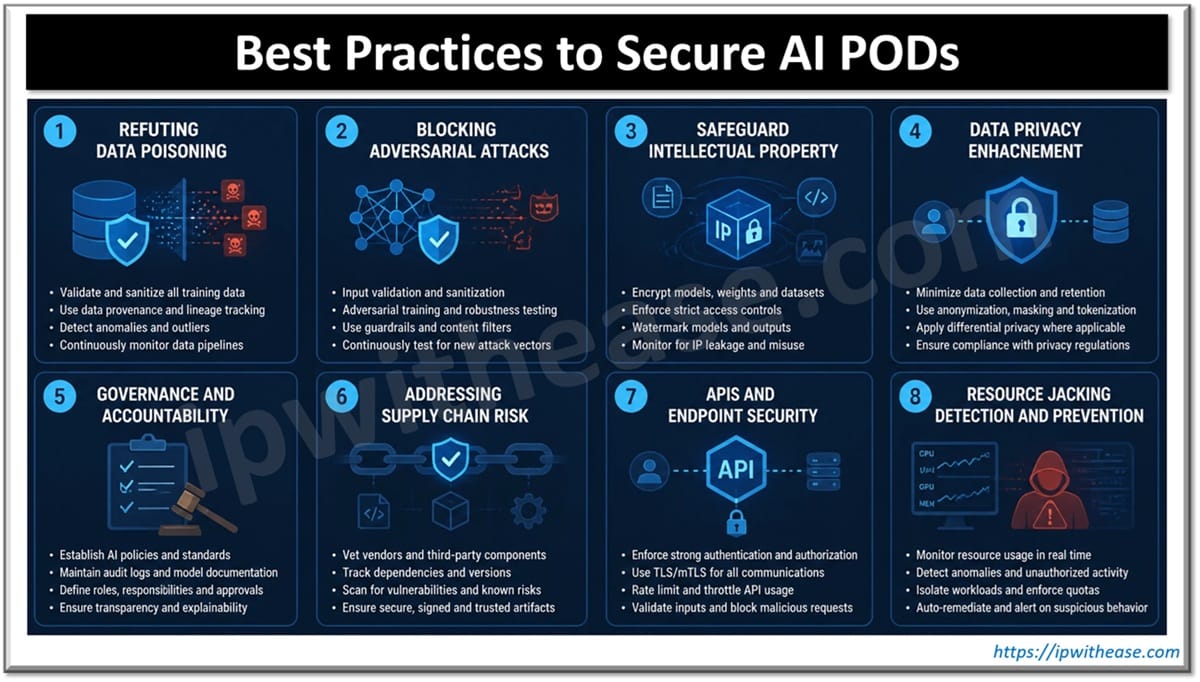
Best Practices to Secure AI PODs
In this section we will look at some best practices which can be implemented to secure AI workloads.
Refuting Data Poisoning
To evade data poisoning risk it is important to focus on data quality. Rigorous validation checks, anomaly detections in datasets, data pipelines real-time monitoring to identify and neutralize threats. To reduce vulnerabilities and malicious tempering usage of diverse and representative data sets is helpful.
Blocking Adversarial Attacks
Adversarial training of AI models is crucial. Simulating attack scenarios in the development stage of AI models help models to learn and identify malicious inputs and counteract them. Applying additional layers of defence to filter out deceptive inputs provides another check.
Safeguard Intellectual Property
Model encryption during rest and transit, robust authentication using API keys and Multi-factor authentication and securing the end points are some measures here. Model monitoring is crucial to identity and unusual access patterns.
Data Privacy Enhancement
Data anonymization for sensitive fields, role based access control (RBAC) for need based data exposure only to authorized personnel, regular audits to verify if privacy controls are implemented in line with privacy regulation requirements help in identification of potential breaches.
Governance and Accountability
Adoption of Explainable AI frameworks (XAI) help in building transparency, trust and enable oversight. A strong governance structure establishes clear accountabilities.
Addressing Supply Chain Risk
Through check and validation of third party components used in AI systems. Vet datasets and frameworks to identify vulnerabilities and deploy monitoring tool for early detection of potential risks. Signed and verified external components reduce the exposure to an extent from malicious code or hidden vulnerabilities.
APIs and Endpoint Security
- API access should be authenticated using highly secure mechanisms such as OAuth tokens.
- Apply rate limit – excessive requests to API should be prohibited to counter abuse
- Input validation – injection attacks can be avoided if input conform to expected format
- Usage monitoring – Signs of malicious or anomalous activity can be detected by monitoring API transactions
Resource Jacking Detection and Prevention
Strict access control with robust monitoring can address this risk. Monitoring alerts should raise an alarm on anomalous resource usage patterns and potential jacking attempts.
ABOUT THE AUTHOR

You can learn more about her on her linkedin profile – Rashmi Bhardwaj