Table of Contents
Think of an online store. At first, it has a simple checkout. Later, you add promo codes, new payment options, and delivery integrations. After every change, regression testing runs to make sure the old features still work. The problem shows up when the product has changed a lot.
Some tests check outdated behavior, some repeat the same checks, and some new risky areas aren’t covered at all. So the regression suite still says “all good,” but real issues are starting to slip into new flows after changes to the system.
What is Regression Testing Strategy?
A regression testing strategy is an agreement within the team on how they check the product after every change to determine whether anything important was broken.
You have a product, and you constantly change it by adding features, updating logic, and fixing things. A regression testing strategy defines which checks to run after these changes and why, so the team can confidently conclude: “Yes, this release is safe to move forward.” Read more on site about testing types and general approaches to choosing checks.
But we’d better focus specifically on regression testing strategy problems: why it stops working, how the regression suite falls behind the product, and why “all tests are green” does not always mean a safe release.
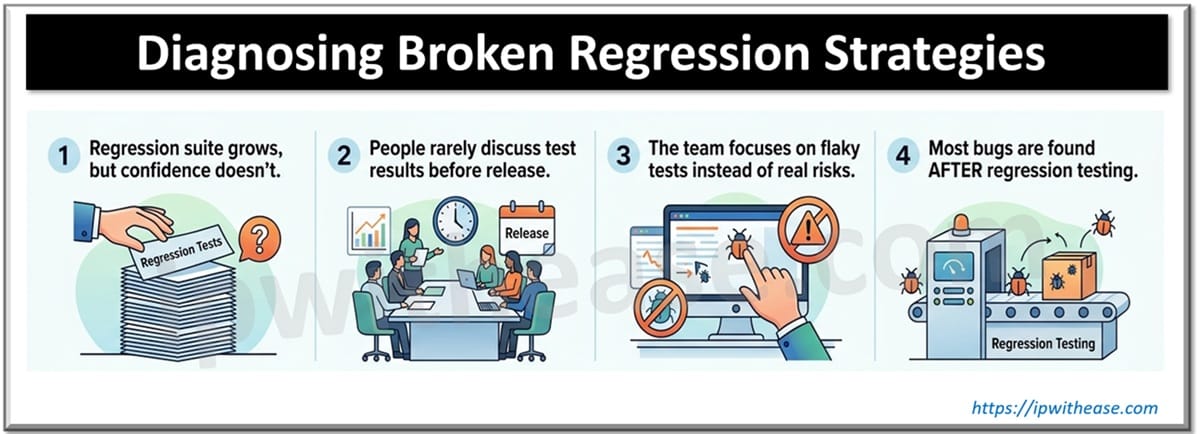
Diagnosing Broken Regression Strategies
Testing consultants usually don’t start with tools or automation. They check one simple thing: does regression help the team decide if a release is safe? If the team can’t explain what’s most risky to miss, the strategy already loses focus.
Typical signs of problems:
- The regression suite keeps growing, but confidence in releases doesn’t improve
- People rarely talk about test results before release
- The team pays more attention to flaky tests than to real product risks
- Most bugs don’t come from regression testing
From a consultant’s point of view, the issue isn’t the number of tests. The real problem is that regression testing starts checking old product behavior instead of focusing on current risks in the system.
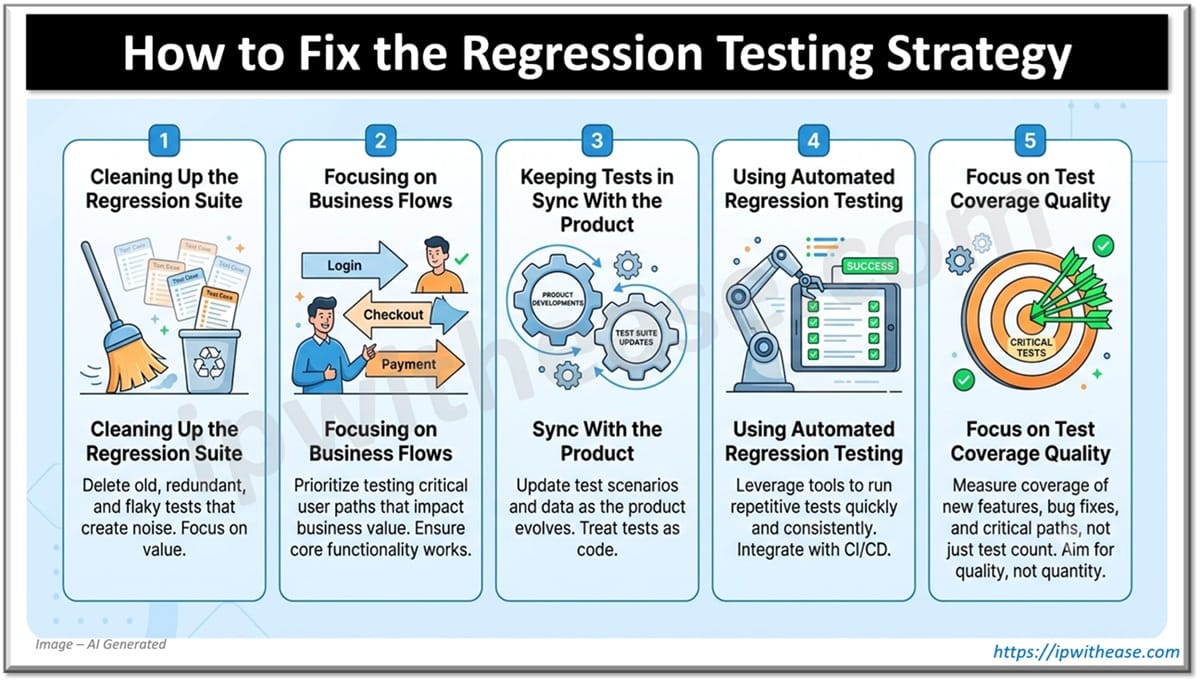
How to Fix the Regression Testing Strategy
When a regression strategy stops working, you don’t fix it with one simple step. It’s not about single tests, but the whole setup. You need to look at how you pick tests, how you keep them up to date, and how you use their results when you decide if a release is ready.
There are a few practical ways to do this:
Cleaning Up the Regression Suite
Get rid of old and duplicate tests that no longer match how the product works today. If a test still checks a login from a “past version of life” or a payment flow that has already been rebuilt, it only creates chaos in the results. Less noise means more clarity, and if something shows up after that, it’s a real problem, not a possible or theoretical one.
Focusing on Business Flows
Pick the main user flows and focus on those, like registration, checkout, or payment. These are the things that actually matter for users and the business, so they should be tested first, not smaller side features.
Keeping Tests in Sync With the Product
Update regression tests whenever the product changes. If the checkout flow changes from “address – payment” to “address – delivery option – payment”, you update the test to include that new step. If the product replaces a card payment screen with Stripe, you change the test instead of still checking the old card form. Or the suite keeps running old checks that don’t match the real product anymore.
Using Automated Regression Testing
Automated regression testing helps you run checks fast, but only works well when you build it on up-to-date scenarios. If you automate old tests, you just run old problems faster or get results that don’t mean much anymore. For example, if the UI changes but the test still clicks the same old button, it won’t reflect how the product actually works.
Focus on Test Coverage Quality
In reality, a long list of random checks is nowhere near as useful as a few tests that actually make sense. Don’t chase numbers – many of those tests quickly become outdated and stop showing what’s really going on. Each test should check something important and show whether the main flow works or not.
What Regression Testing Should Cover
Regression testing protects the product from breaking after changes. The product keeps changing, so tests need to follow those changes. The regression suite often either grows too big or stops reflecting what actually matters in the system.
Teams usually choose one of these variants: maintain regression on their own, bring in QA specialists to review and improve it, or combine both approaches.
So, whatever approach you choose, regression testing should match the current state of the product, not an older version.
ABOUT THE AUTHOR

IPwithease is aimed at sharing knowledge across varied domains like Network, Security, Virtualization, Software, Wireless, etc.