Table of Contents
Once you move past gigabit Ethernet, cable selection stops being a commodity decision and starts being an engineering one. Cat6, Cat6a, and Cat7 all show up in spec sheets for “high performance” networks, but they solve different problems, and one of them (Cat7) is more complicated to deploy than most people realize.
While planning and selecting Cabling infrastructure, it is essential to consider future growth plan and roadmap to expand. Here’s how they actually compare.
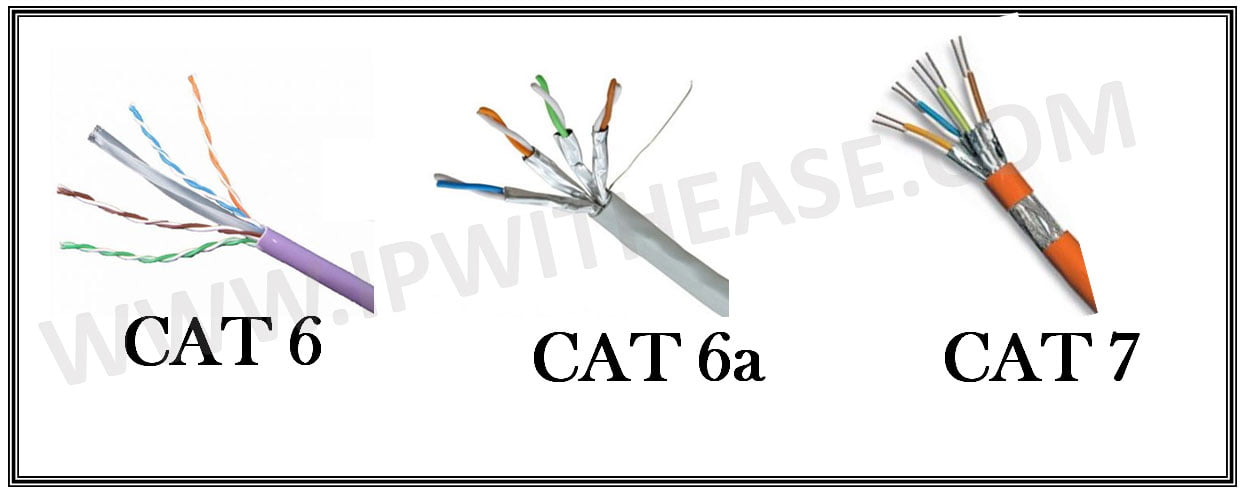 CAT6 vs CAT6A vs CAT7
For active infrastructure (Router, Switch, Firewall etc.), technology changes require refreshing the networking equipment’s every 5-7 years, however, passive infrastructure can sustain much longer, hence requires more diligence and wise decision making. When it comes to data Centers and Large Corporate offices, it is generally preferred to opt for Cat6 / Cat6A or Cat7. Cat6 and Cat7 are known to support bandwidth up to 10 Gbps and are generally shielded to minimize interference and cross talk. Moving from Cat6 to Cat7 incurs an additional cost which may range from 20% to 50%.
Cat6: Solid Gigabit, Conditional 10G
Cat6 supports 250 MHz of bandwidth and is the standard most offices settle on when gigabit is the baseline requirement. Its numbers:
- 1 Gbps up to 100 meters
- 10 Gbps up to roughly 55 meters, shorter in bundled or noisy environments due to alien crosstalk
That 55-meter cap for 10G is the defining limitation. Cat6 was standardized before 10-Gigabit Ethernet over copper matured, so it can technically carry it, but only over shorter runs — usable for rack-to-rack or short patch connections, not for a full horizontal cable run from a wiring closet to a desk.
Cat6 uses unshielded twisted pair (UTP) in most installs, keeping it relatively easy to terminate and route.
Cat6a: 10G Without the Distance Penalty
Cat6a doubles bandwidth to 500 MHz and is purpose-built to remove Cat6’s distance restriction:
- 10 Gbps over the full 100-meter run
It does this with tighter construction and better resistance to alien crosstalk, often through shielded designs (F/UTP or S/FTP). The cable is thicker and stiffer than Cat6, costs more, and needs more careful termination — but for any environment where 10G needs to be reliable at full standard distance, Cat6a is the current sweet spot between performance and practicality.
This is the tier most new commercial installs and data centers standardize on today.
Cat7: More Bandwidth, More Caveats
Cat7 pushes bandwidth to 600 MHz and is built around fully shielded pairs (S/FTP), where each individual pair is shielded and the whole cable is shielded again. This gives excellent noise immunity and supports 10 Gbps comfortably over 100 meters, with headroom above what Cat6a offers in noisy environments.
The catch is standardization and connectors. Cat7 was defined under ISO/IEC standards, not the TIA/EIA framework that governs Cat5e/Cat6/Cat6a in North America, and it wasn’t designed to work with standard RJ45 connectors — proper Cat7 termination uses GG45 or TERA connectors to achieve its full rated performance. Many “Cat7” cables sold with RJ45 ends are effectively downgraded to Cat6a-level performance at the connector, which defeats the purpose of buying Cat7 in the first place.
Because of this, Cat7 never gained broad adoption in structured cabling for commercial LANs, particularly in the US. It shows up more often in specialized European installations or environments demanding heavy shielding for EMI reasons, rather than as a mainstream upgrade path.
Practical note: most vendors have shifted attention to Cat8 for extreme short-reach (30m) 25/40 Gbps applications rather than pushing Cat7 further, which reinforces that Cat7 is something of a dead branch in the cabling family tree.
Related- CAT6 vs CAT5E
Comparison Table: Cat6 vs Cat6A vs Cat7
Below table enumerates the difference between Cat6, Cat6a and Cat 7 –
| Parameter | Cat6 | Cat 6a | Cat 7 |
|---|---|---|---|
| Speed Supported | 10 G upto ~ 30 to 50 meters | Upto 10 Gbps | Above 10 Gbps |
| Cable Type | UTP/STP | STP | S/FTP |
| Frequency | 250 MHz | 500 MHz | 600 MHz |
| Cost | Lower than CAT 6a | 20-30% higher than CAT 6 | 20-30% higher than CAT 7a |
| Connector Type | Rj45 | Rj45 | GG45 |
| Target customer | Office networks | Large Corporate offices | Data Center |
| Standard Gauge | 22-24 AWG | 16-20 AWG | 22-26 AWG |
Download the comparison table: cat 6 vs cat6a vs cat7
Related Video
Continue Reading
Passive Networking and Cabling Interview Questions
Disclaimer: This blog contains affiliate links. If you purchase through these links, we earn a small commission at no extra cost to you, but that is what keeps this blog alive and the helpful content coming your way.
ABOUT THE AUTHOR

You can learn more about her on her linkedin profile – Rashmi Bhardwaj