Table of Contents
For seven years, the foldable conversation was mostly Samsung talking to itself, with Google, Huawei and a few others chiming in. That changed on September 9, 2026, when Apple finally put a hinge in an iPhone and called it the iPhone Duo.
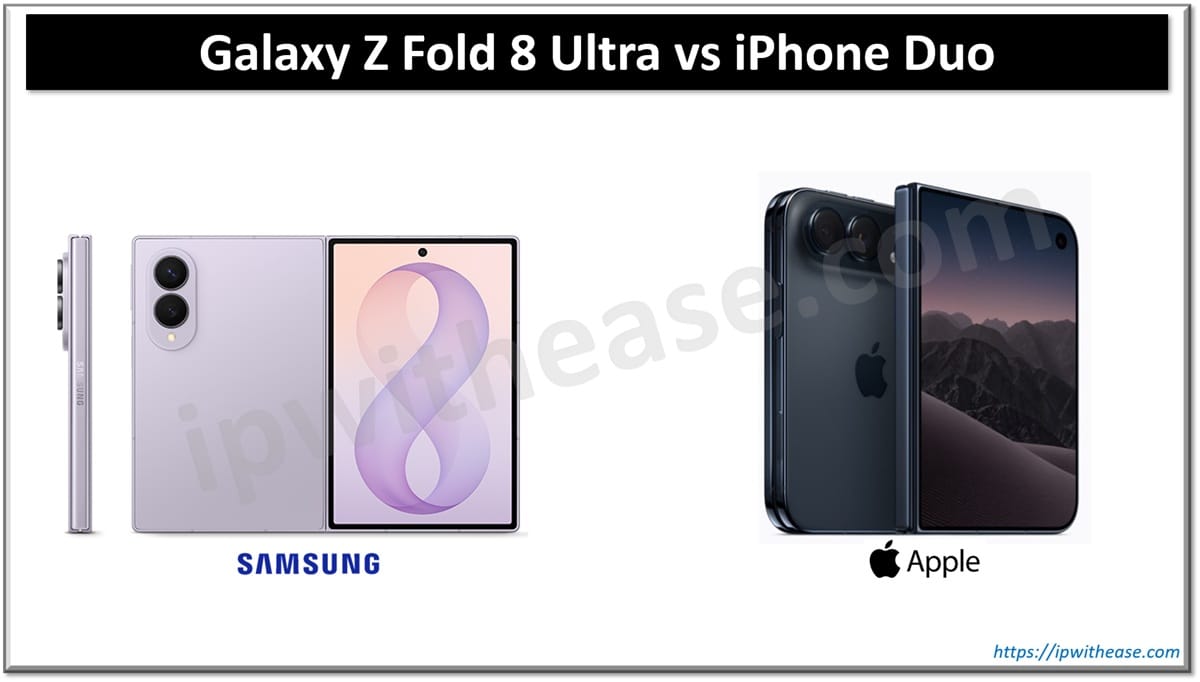
The timing is interesting. Just seven weeks earlier, Samsung launched the Galaxy Z Fold 8 Ultra, the first time it has put the “Ultra” badge on a foldable. So we now have two very different answers to the same question: what should a premium folding phone look like in 2026?
Samsung went tall, thin and camera-heavy. Apple went short, wide and chunky, and leaned on software polish. Neither is objectively “better”. They’re built for different people, and the right one depends on how you’ll actually use it.
A quick note before we start. The Fold 8 Ultra has been on sale since August 7, so there’s real-world usage behind it. The iPhone Duo opens for pre-orders on October 16 and ships October 23, so for Apple we’re working from announced specs and early hands-on impressions. We’ll update this post once we’ve lived with both.
Quick Verdict
If you want the biggest screen, the best zoom camera and the thinnest body, and you’re comfortable on Android, the Galaxy Z Fold 8 Ultra is the more capable machine on paper.
If you live in the Apple ecosystem, care more about durability than thinness, and want a foldable that also works as a genuinely one-handed phone when closed, the iPhone Duo is the one to wait for.
In India, price may settle it for a lot of buyers. The Duo costs roughly one lakh rupees more than the Fold 8 Ultra at the base storage tier.
Specs at a Glance: Galaxy Z Fold 8 Ultra vs iPhone Duo
| Spec | Galaxy Z Fold 8 Ultra | iPhone Duo |
|---|---|---|
| Inner display | 8.0″ Dynamic AMOLED 2X, 2504 x 2256, 120Hz | 7.6″ Super Retina XDR, ProMotion, nano-texture |
| Cover display | 6.5″ Dynamic AMOLED 2X, 120Hz | 5.4″ Super Retina XDR, ProMotion |
| Thickness (open / closed) | 4.1 mm / 8.9 mm | 5.2 mm / 11.3 mm |
| Weight | 215 g | 254 g |
| Chip | Snapdragon 8 Elite Gen 5 for Galaxy | Apple A20 Pro |
| RAM | 12GB / 16GB (1TB model) | Not disclosed by Apple |
| Storage | 256GB, 512GB, 1TB | 256GB, 512GB, 1TB, 2TB |
| Rear cameras | 200MP main + 50MP ultra-wide + 10MP 3x telephoto | 48MP Fusion main + 48MP Fusion ultra-wide |
| Zoom | 3x optical, up to 30x Space Zoom | 2x optical-quality (sensor crop) |
| Max video | 8K at 30fps | 4K at 120fps Dolby Vision |
| Battery | 5,000 mAh (dual cell) | Dual cell, capacity not disclosed |
| Wired charging | 45W, about 67% in 30 min | About 50% in 20 min |
| Wireless charging | 20W, plus reverse wireless | MagSafe / Qi2, about 50% in 30 min |
| Water / dust | IP48 | IP68 |
| Biometrics | Side fingerprint sensor | Touch ID in side button (no Face ID) |
| SIM | Physical SIM + eSIM | eSIM only |
| Stylus | No | Apple Pencil (USB-C) support coming later this year |
| OS | Android 17, One UI 9 | iOS 27 |
| US price (256GB) | $2,099.99 | $1,999 |
| India price (256GB) | ₹1,99,999 | ₹2,99,900 |
Design and Build: Tall and Thin vs Short and Solid
This is where the two phones differ the most, and it’s the first thing you’ll notice when you pick them up.
Samsung has stuck with the classic book-style shape, just refined almost to the limit. Unfolded, the Fold 8 Ultra is only 4.1 mm thick, and it’s 8.9 mm closed, which is barely thicker than a regular slab phone. At 215 g, it’s also lighter than most non-folding flagships. Samsung uses Armor Aluminum for the frame and a new “Flex Titanium” display structure, which pairs a titanium-alloy film with a titanium plate under the screen to cut down on crease visibility and absorb impacts.
Apple took a different route entirely. Closed, the iPhone Duo is roughly the shape of a passport: shorter and wider than the Samsung. It’s 5.2 mm thin when open (Apple’s thinnest iPhone ever in that state), but 11.3 mm closed, which makes it the thickest iPhone since the 3GS. It also weighs 254 g, which is 39 g more than the Fold 8 Ultra and even a touch heavier than the iPhone 18 Pro Max.
That extra weight isn’t wasted, though. The frame is Grade 5 titanium, the hinge has more than 100 components, and there’s Ceramic Shield 2 on the front and Ceramic Shield on the back.
The bigger durability story is ingress protection. The iPhone Duo is IP68, meaning it’s sealed against both dust and water. The Fold 8 Ultra is IP48, which covers water immersion but only protects against solid particles larger than 1 mm. Samsung itself says the phone isn’t advised for beach or pool use. If you commute on dusty roads, work on-site in data centres or plant floors, or just keep your phone in a pocket full of lint, that difference matters more than it looks on a spec sheet.
Our take: Samsung wins on pocketability and weight. Apple wins on toughness.
Displays: Bigger Canvas vs Better Consistency
Open the Fold 8 Ultra and you get an 8-inch inner display, the largest Samsung has put on a Fold. It’s a proper multitasking canvas, and three apps side by side actually feel usable rather than cramped. The 6.5-inch cover screen is also full-sized, so you can do almost everything without unfolding.
The iPhone Duo’s inner screen is smaller at 7.6 inches, but Apple made an interesting design choice: both the 5.4-inch outer screen and the inner screen share the same aspect ratio. Apps scale up proportionally when you open the phone instead of reflowing into a different layout. The inner screen is close to 4:3, which makes it feel more like a pocket iPad mini than a stretched phone. Video and games tend to fill it better, with less letterboxing.
Both phones hit up to 3,000 nits outdoors and both run at up to 120Hz. Apple adds a matte nano-texture finish on the inner display, which should help with glare and make the crease less obvious. It also puts the inner FaceTime camera under the display, so there’s no punch-hole in the middle of your content.
The 5.4-inch cover screen deserves a mention too. It’s the first 5.4-inch iPhone since the iPhone 13 mini. If you’ve missed a truly one-handed iPhone, the Duo gives you that when closed and an iPad-mini-like screen when open.
Our take: Fold 8 Ultra for raw screen space and productivity. iPhone Duo for media, reading and a more seamless fold-to-unfold experience.
Performance
Both phones run the best chips their ecosystems currently have.
The Fold 8 Ultra uses the Snapdragon 8 Elite Gen 5 for Galaxy, a 3nm chip, with 12GB of RAM (16GB on the 1TB model). Samsung has also added an expanded graphite cooling system to keep it from throttling during long sessions.
The iPhone Duo gets the A20 Pro, built on TSMC’s 2nm process, the same chip family as the iPhone 18 Pro. Apple pairs it with a vapor chamber and claims up to 35% better sustained performance than the iPhone 17 Pro.
In day-to-day use, neither of these will feel slow. The real differentiator is how each OS uses the big screen, which we cover in the software section below.
Cameras: Samsung Pulls Ahead
This is the clearest win in the comparison.
The Fold 8 Ultra has a genuine flagship camera setup: a 200MP main sensor, a new 50MP ultra-wide and a 10MP telephoto with 3x optical zoom, going up to 30x Space Zoom. It records 8K video at 30fps and supports Samsung’s new APV codec and Cine LUTs, which are aimed at people who edit their footage seriously.
The iPhone Duo has two rear cameras: a 48MP Fusion main and a 48MP Fusion ultra-wide. There’s no dedicated telephoto lens. The 2x option is a crop from the main sensor, which is fine for portraits but won’t touch Samsung’s 3x optics, let alone its long-range zoom. Apple does have 4K at 120fps with Dolby Vision, which is excellent for slow-motion and cinematic footage.
Apple has some clever foldable-specific tricks. Duo Preview lets the subject see themselves on the outer screen while you shoot with the main camera, and Smart Take uses on-device AI to capture the moment automatically when your subject is ready. Samsung has had similar rear-camera selfie modes for a while, so this is Apple catching up rather than leapfrogging.
Our take: If camera versatility, zoom in particular, matters to you, the Fold 8 Ultra is the easy pick.
Battery and Charging
Both phones use a dual-cell battery, one on each side of the hinge.
Samsung is upfront about capacity: 5,000 mAh, the biggest ever in a Galaxy Fold. It charges at 45W wired (Samsung quotes about 67% in 30 minutes with its 45W adapter, sold separately), supports 20W wireless and can reverse-charge your earbuds or watch.
Apple hasn’t published a capacity figure, as usual. It rates the Duo for up to 31 hours of video on the inner screen and 44 hours on the outer screen. Fast charging hits about 50% in 20 minutes wired, and MagSafe/Qi2 gets to 50% in about 30 minutes. There’s no charger in the box in India, only the cable.
We’ll need independent testing before calling a winner. On paper, the Duo’s longer rated video playback is impressive, but Apple’s figures are measured differently from Samsung’s, so treat direct comparisons with caution.
Software and Ecosystem
Hardware only gets you halfway on a foldable. The software decides whether the big screen is useful or just big.
Samsung has had seven generations to refine One UI for folding screens, and it shows. Multi-window, taskbar, drag-and-drop between apps and pop-up windows all feel mature. One UI 9 on Android 17 adds a lot of AI features too, including Now Brief, Now Nudge (which suggests actions based on what you’re discussing in chats) and Gemini Intelligence, which can automate tasks across more than 40 apps. There’s also a new AI Assistant Activity dashboard that shows you what the AI has done on your behalf, which is a thoughtful touch from a privacy point of view.
Apple is starting from scratch on foldables, but iOS 27 has clearly been built with the Duo in mind. You get split view for two apps, a pinned video player that floats above other apps, a “seated” half-folded mode for video calls or workouts, and even a tent mode that turns the phone into a bedside clock. Apple Pencil support is also coming later this year, which is something Samsung dropped from the Fold line starting with the Fold 7.
If you already use a Mac, iPad and Apple Watch, the Duo slots straight in. If you’re coming from Android, the Fold 8 Ultra has a far more mature large-screen multitasking setup today.
One helpful detail for switchers: Samsung’s updated Smart Switch can now move data wirelessly from an iPhone using a QR code, and Quick Share now works with AirDrop, so moving between the two camps is less painful than it used to be.
For IT Pros: Connectivity, SIM and Enterprise Considerations
Since a lot of our readers manage fleets of devices or travel for work, a few details are worth calling out.
- eSIM only on the iPhone Duo. There’s no physical SIM tray in any country, including India. Apple says this freed up internal space for the batteries. That’s fine on major Indian carriers, but if you rely on picking up a local physical SIM when travelling, or your organisation still provisions physical SIMs, plan ahead. The Fold 8 Ultra keeps a physical SIM alongside eSIM.
- Biometrics. The Duo drops Face ID entirely in favour of Touch ID on the side button. That works the same whether the phone is open or closed, and it’s friendlier when you’re wearing a mask on a site visit. Samsung uses a side-mounted fingerprint sensor too.
- Wireless. The Fold 8 Ultra supports Wi-Fi 7 and Bluetooth 6.0. The Duo uses Apple’s in-house C2 modem, the next step in Apple moving away from Qualcomm. Real-world 5G performance on Indian networks is something we’ll be watching closely.
- Device management. Both platforms are enterprise-ready. Samsung Knox (including Knox Vault and the new KEEP encrypted storage for on-device AI data) remains one of the stronger Android security stacks, while the Duo will work with existing Apple Business Manager and MDM setups like any other iPhone.
Price and Availability
This is where things get very different depending on where you live.
In the US, the Galaxy Z Fold 8 Ultra starts at $2,099.99 and the iPhone Duo starts at $1,999. Apple is actually the slightly cheaper option at the base tier, although it’s pricier than the standard Galaxy Z Fold 8 ($1,899.99).
In India, the picture flips completely:
| Storage | Galaxy Z Fold 8 Ultra | iPhone Duo |
|---|---|---|
| 256GB | ₹1,99,999 | ₹2,99,900 |
| 512GB | ₹2,19,999 | ₹3,24,900 |
| 1TB | ₹2,59,999 | ₹3,74,900 |
| 2TB | Not offered | ₹4,49,900 |
That’s roughly a ₹1 lakh gap at every tier. For Indian buyers, the iPhone Duo is the most expensive iPhone Apple has ever sold here, and it’s hard to ignore that you can buy a Fold 8 Ultra and still have enough left over for a good laptop.
The Fold 8 Ultra is on sale now in Graphite, Cream, Violet Shadow and Green Shadow (online exclusive). The iPhone Duo comes in Star White and Night Sky, with pre-orders from October 16 and sales from October 23 across more than 70 countries, including India.
Who Should Buy Which?
Choose the Galaxy Z Fold 8 Ultra if:
- You want the largest foldable screen and serious multitasking
- Zoom photography and 8K video matter to you
- You care about a thin, light phone in your pocket
- You’re in India and the ₹1 lakh difference is a real consideration
- You need a physical SIM slot
Choose the iPhone Duo if:
- You’re already invested in iPhone, Mac, iPad and Apple Watch
- You want IP68 dust and water protection on a foldable
- You’d like a compact one-handed phone that opens into an iPad mini-sized screen
- You plan to use an Apple Pencil for notes or sketching
- You’re comfortable being a first-generation buyer
Frequently Asked Questions
Q.1 Is the iPhone Duo better than the Galaxy Z Fold 8 Ultra?
Not across the board. The Fold 8 Ultra has a bigger screen, a better camera system with real optical zoom, and a thinner, lighter body. The iPhone Duo has better dust and water resistance, Apple Pencil support and tighter integration with Apple devices.
Q.2 Does the iPhone Duo have Face ID?
No. Apple replaced Face ID with Touch ID built into the side button.
Q.3 Is the Galaxy Z Fold 8 Ultra dustproof?
Not fully. It’s rated IP48, which covers water immersion but only protects against solid particles larger than 1 mm. The iPhone Duo is IP68.
Q.4 Does the iPhone Duo support a physical SIM in India?
No. The iPhone Duo is eSIM-only in every market.
Q.5 Which is cheaper in India?
The Galaxy Z Fold 8 Ultra, by around ₹1 lakh at each comparable storage tier.
Final Thoughts
It’s genuinely good news for buyers that Apple has entered the foldable market. Samsung now has a serious rival, and Apple has a benchmark it has to beat.
Right now, the Galaxy Z Fold 8 Ultra is the more complete foldable: bigger screen, better cameras, thinner build and years of refined software behind it. The iPhone Duo is the more interesting first attempt, with smart design choices around aspect ratio, durability and one-handed use, but it asks you to accept extra weight, a missing telephoto lens and, in India, a very steep price.
If you need a foldable today, the Fold 8 Ultra is the safer bet. If you’re an iPhone user who has been waiting years for Apple to do this, the Duo will probably be worth the wait. Just maybe let the first round of real-world reviews come in before you commit three lakh rupees.
Which one would you pick? Let us know in the comments.
Disclaimer
The specifications, features and prices in this article are based on information available at the time of writing (September 30, 2026) and may change without notice. Prices can vary by region, retailer, carrier and ongoing offers, and some iPhone Duo details are based on Apple’s announcement ahead of its October 23 release. Please check the official Samsung and Apple websites or your local retailer for the latest information before making a purchase.
This blog contains affiliate links. If you purchase through these links, we earn a small commission at no extra cost to you, but that is what keeps this blog alive and the helpful content coming your way.
ABOUT THE AUTHOR

IPwithease is aimed at sharing knowledge across varied domains like Network, Security, Virtualization, Software, Wireless, etc.