Table of Contents
Generative AI and Applied AI get used interchangeably in a lot of course marketing, which creates real confusion for learners trying to choose between options. They’re not the same thing. Understanding the actual difference helps you select the learning path that matches your goals rather than defaulting to whichever label sounds more relevant.
What is Generative AI
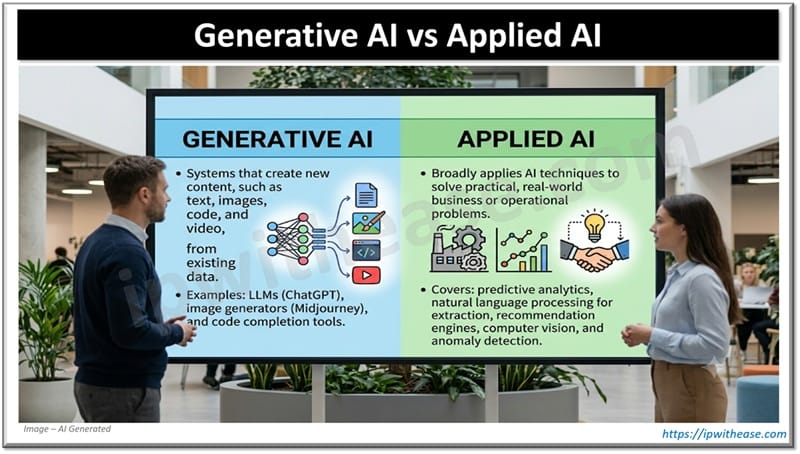
Generative AI is a specific category of AI technology. Systems that create new content — text, images, code, audio, video, synthetic data — rather than classifying, predicting, or retrieving existing information. The defining characteristic is that the output is generated, not selected.
- LLMs are generative AI.
- Image generation models are generative AI.
- Code completion tools are generative AI.
Generative AI Courses focused specifically on this category cover how these systems work, how to use them effectively, how to build applications that incorporate them, and how to evaluate their outputs.
In many professional contexts, both perspectives are relevant. A data analyst working in marketing might need generative AI for content personalization but also needs predictive analytics for campaign planning and customer segmentation. A product manager building AI-powered features might encounter both language model integration for content generation and classification models for content moderation. The most practically useful professionals in AI-adjacent roles tend to have both the specific generative AI fluency and the broader applied AI context that lets them evaluate which type of AI approach fits which type of problem.
The career trajectory implications differ depending on role orientation. Professionals building toward technical AI roles benefit from Generative AI Courses depth as a current priority given where the market is concentrated, while also developing broader applied AI context over time. Professionals in functional roles benefit more from the applied AI framing that an Applied AI Course provides — connecting technology capabilities directly to function-specific use cases rather than treating AI as a discipline to be studied separately from the work it enables.
What is Applied AI
Applied AI is broader. It covers the practical application of AI techniques. Any AI techniques to real business or operational problems. That includes generative AI, but it also includes predictive models, classification systems, recommendation engines, anomaly detection, computer vision, natural language processing for extraction rather than generation. Applied AI as a discipline is less interested in which category of AI you’re using and more interested in whether you’re using it correctly to solve the problem at hand. An Applied AI Course built around this framing gives you a broader toolkit:
- multiple types of AI approaches,
- the judgment to match approach to problem type, and
- practical skills for deploying AI solutions across different organizational contexts.
Which one to prioritize? Generative AI vs Applied AI
With the AI learning market exploding, professionals face a confusing fork: should you invest time understanding how AI models work, or focus on using them to solve real problems? Here are five dimensions that settle the debate.
- Career alignment matters most. Generative AI courses are built for ML engineers and researchers who want to fine-tune models or work inside AI labs. Applied AI courses target the much larger population of professionals – architects, developers, and tech leads who need to integrate AI into existing systems. If you’re not building foundation models, Applied AI is your lane.
- Time-to-value is dramatically different. A Generative AI curriculum can take 3–6 months before you produce anything portfolio-worthy. Applied AI courses using tools like LangChain, LlamaIndex, and cloud AI APIs let you build and deploy a working RAG pipeline or AI agent in 2–4 weeks.
- Certification paths are clearer with Applied AI. AWS AI Practitioner, Microsoft Azure AI-102, and Google Cloud Professional ML Engineer are all grounded in applied skills — deploying models, integrating APIs, designing AI-ready architectures. These map directly to job descriptions at enterprise and consulting firms.
- Generative AI gives you depth, not breadth. Once you have working applied skills, learning how transformers and attention mechanisms work makes you a stronger voice in architecture reviews and vendor evaluations. It is a powerful second layer — but a poor starting point for most practitioners.
- The industry hires for applied skills today. Job descriptions in 2026 ask for RAG experience, vector database knowledge, agentic workflow design, and MLOps familiarity — not transformer theory. Applied AI keeps you hireable; Generative AI keeps you credible.
Final Words
What makes the generative AI versus applied AI distinction practically important is what it implies for depth versus breadth of development. If you invest primarily in generative AI depth, you become highly capable with a specific technology category that’s getting a lot of attention right now, and potentially less familiar with the full range of AI approaches that your organization might need for different problem types.
If you invest primarily in applied AI breadth, you understand the landscape and can navigate it intelligently, but you may lack the specific generative AI fluency that many 2026 roles are specifically looking for. The combination of Generative AI Courses depth and Applied AI Course breadth developed over time is what produces the most versatile and well-compensated professionals in this space.
ABOUT THE AUTHOR

IPwithease is aimed at sharing knowledge across varied domains like Network, Security, Virtualization, Software, Wireless, etc.