
Table of Contents
Modern attack surfaces can change in an instant. Organizations that run penetration tests once or twice a year only end up with a partial, fast-aging view of their risk. An automated pentesting approach addresses this issue by continuously scanning the environment, and it is most effective when human pentesters only step in to validate and act on what the automation surfaces.
Research has found that 58% of organizations now utilize penetration testing as a service (PTaaS), a model that pairs continuous automated scanning with human testers who validate and act on what surfaces. What’s more, 53% say point-in-time testing goes stale before results can be acted on.
Here’s what’s driving that shift.
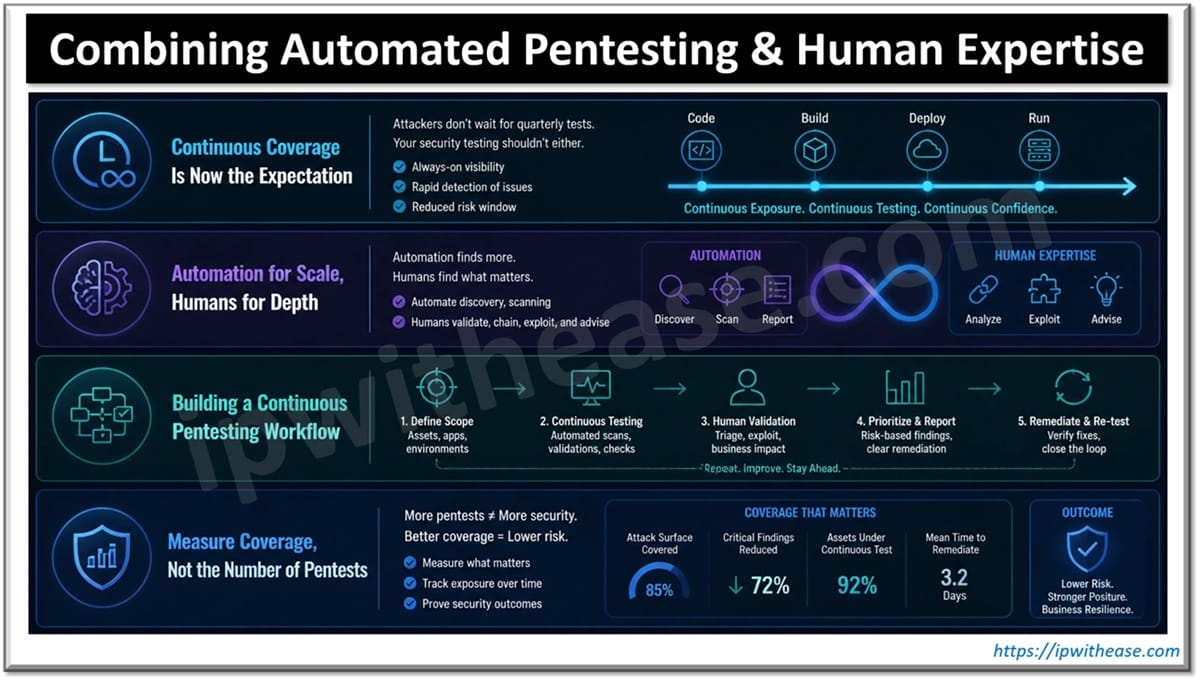
Automated Pentesting & Human Expertise
Continuous Coverage Is Now the Expectation
The core benefit here is simple. The environment is analyzed continuously, so every new asset is covered as it’s introduced, not months later. Point-in-time assessments, especially the once-or-twice-a-year kind, go stale fast. A report that reflects the reality in January says little about what’s exposed in February, let alone even later.
With continuous testing, organizations have a live view of their environment instead of a snapshot. That kind of visibility is the baseline organizations now need just to keep up with how fast their environment moves. Gartner has been making a similar case with its Continuous Threat Exposure Management (CTEM) framework, which recommends the same kind of ongoing, cyclical approach over periodic assessments.
A misconfigured cloud bucket or an exposed API endpoint doesn’t wait for the next scheduled pentest to become a problem. It’s exploitable the moment it appears, and continuous testing is what closes that window before an attacker gets to it.
Automation for Scale, Humans for Depth
Automation and human testers are good at different things, and letting each focus on its strength is the whole point.
Automation is built for scale. It handles the repetitive reconnaissance, tests large numbers of assets in parallel, validates known attack techniques, and retests fixes without getting tired or missing a step. That includes tasks like subdomain discovery, port scanning, and checking large asset inventories against known CVEs. It’s work that would take a human team weeks to do manually.
Human penetration testers are built for depth. They can identify more complex attack patterns involving business logic flaws or authorization issues, and also validate automation findings that need a second look.
Relying solely on automation runs the risk of missing critical vulnerabilities that require creative thinking. On the other hand, a fully human approach simply can’t scale to cover every asset in a fast-changing environment.
Building a Continuous Pentesting Workflow
Here’s how the hybrid model plays out in practice.
Automation continuously scans the environment. It looks for and validates potential attack paths as they appear. All findings are pre-validated and then neatly sorted by risk inside a pentesting platform, where human experts can easily review all critical issues inside a dashboard. They can then either push a fix directly or escalate it to whoever owns that part of the environment.
Each issue that surfaces in these tests comes with context, including a description and remediation guidance, so humans don’t have to spend time digging up basic details or figuring out how to fix it.
Security and dev teams can set up to receive finding notifications in their mailbox, in Slack, or push them straight into Jira or other communication and workflow management tools. Critical findings trigger an immediate alert, while lower-risk issues can sit in the dashboard until someone has time to work through them.
When organizations want to go deeper, they can easily schedule manual pentesting engagements for more complex issues or to test specific, high-value parts of the environment.
Measure Coverage, Not the Number of Pentests
Simply saying how many pentests you conduct each year says little about the extent to which you’ve been able to reduce cyber risk in your environment. The most important factor is coverage, or how much of your attack surface is included in test scopes.
That’s why a hybrid pentesting model works so well. It can cover as much of the environment as you need, not just what fits into a scoped engagement. The entire environment is under constant scanning, while human experts still dig into the specific areas that call for judgment and context.
So instead of counting how many pentests you run, measure the percentage of your attack surface under continuous testing, and how long it takes to find and remediate what shows up.
Why Hybrid Wins
Automated pentesting and human expertise are not meant to compete with each other. Automation keeps pace with the environment, while people catch what pace alone can’t. Attack surfaces today move too fast for either one to handle alone.
The organizations getting this right aren’t picking a side. They’re letting automation scan continuously, sort findings by risk, and hand off the issues that need human intervention. Manual engagements still have a place too, for the complex, high-stakes areas that deserve extra scrutiny.
What matters in the end isn’t which side did the work. It’s whether the attack surface stays covered the whole time and whether critical issues get caught and dealt with promptly.
ABOUT THE AUTHOR

IPwithease is aimed at sharing knowledge across varied domains like Network, Security, Virtualization, Software, Wireless, etc.